Globe artichoke
Cynara cardunculus scolymus
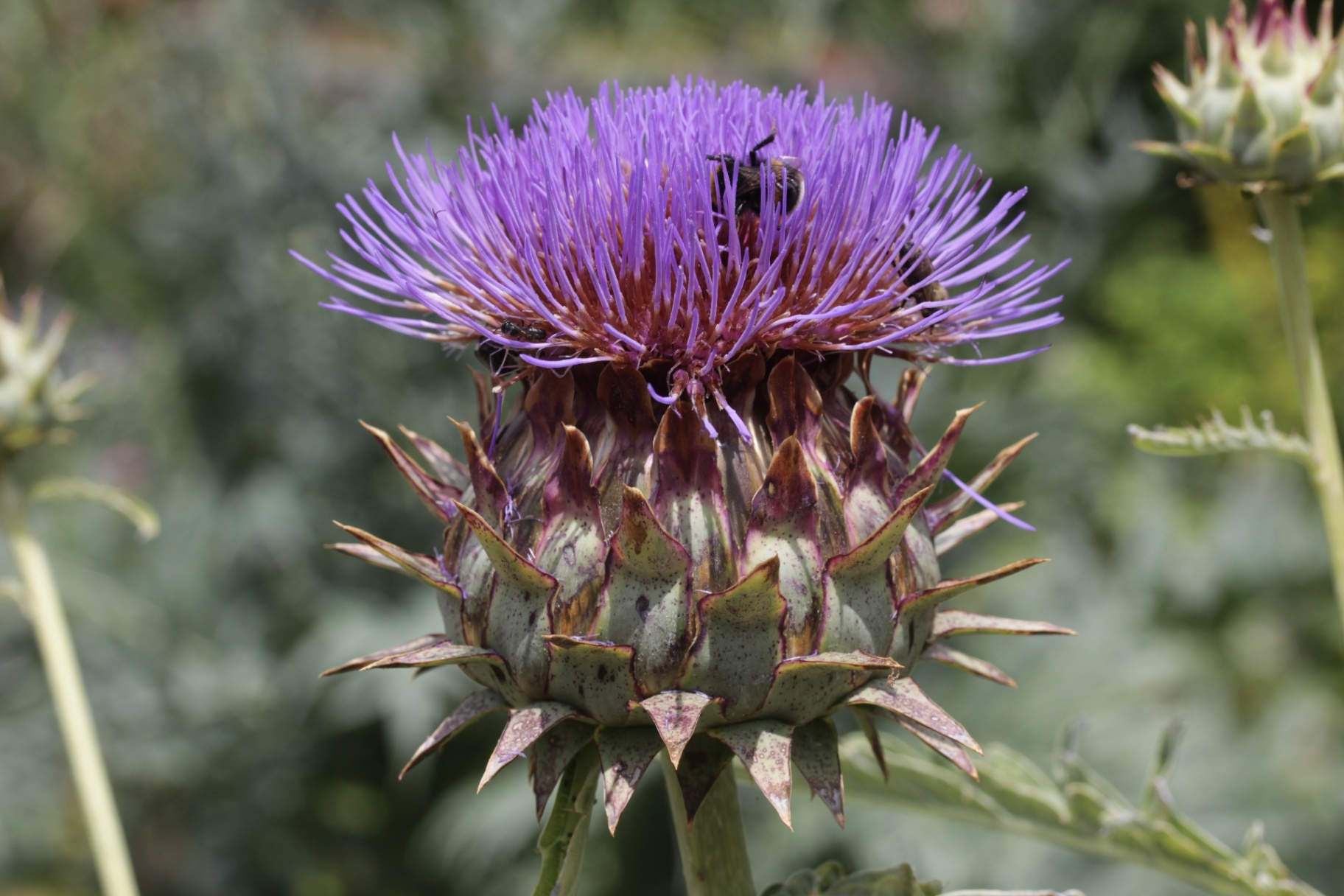
A tall grey-green thistle grown for its unopened flower buds, each a fist-sized globe of overlapping fleshy bracts on a stout ribbed stem. The bud is cut while still tight: the swollen bract bases and the pad of receptacle at the centre are eaten, and the hairy choke of immature florets is discarded. Left to bloom, the head opens to a violet thistle flower and turns woody.
A Mediterranean perennial grown in gardens, allotments and market plots across Britain and Ireland, favouring deep, well-drained soil in full sun. It persists on old cultivation sites and occasionally lingers as a casual escape on waste ground in the milder south.
Eaten with preparation rather than whole: the fibrous outer bracts and the hairy choke are discarded, and bract tips are spine-pointed in some cultivars. Cut surfaces bitter and discolour quickly. Handling the foliage can cause contact dermatitis in people sensitive to the daisy family.
Always use more than one reference to confirm a plant. You are responsible for what you choose to forage.
Flower bud
A rounded to slightly conical head 6–15cm across, made of thick overlapping bracts that are blunt or only shortly spine-tipped in most cultivars. Tight, heavy buds are the ones worth cutting; a head showing violet florets between the bracts is past eating.
Leaves
Deeply pinnately lobed, arching, up to a metre long, dull green above and silvery with fine down beneath. The blade is soft-edged rather than armed, which separates it from the sharply spined leaves of true thistles growing on the same waste ground.
Stem and habit
Stout, grey-green and strongly ribbed, branching to carry several buds and reaching 1.5–2m in its second year. Plants form a broad clump from a perennial crown and die back to it over winter.
Inside the bud
Slice one lengthwise: the fleshy base of each bract sits on a pale pad, the heart, with a mass of immature florets above it. In young buds the florets are soft and edible; once they have developed into fine hairs the choke must be scooped out.
Updated 2026-08-07T21:05:41.454Z · Part of the shared Foragers Log catalogue · Fruit