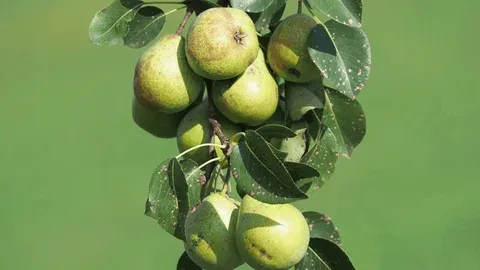
European Wild Pear
Pyrus pyraster
A small thorny tree of hedges and wood edges, reaching 15–20m, with glossy rounded leaves on long stalks and white blossom in April. The fruits are hard little pears, 2–4cm across, gritty and mouth-drying until frost or a few weeks' storage bletts them to brown and sweet. Wild pears in Britain are a muddle of true Pyrus pyraster and feral seedlings of the orchard pear; in practice the thorny spur shoots and the small sour fruit mark out the wild sort. Used for country wines, vinegar, and slow-cooked or spiced preserves rather than eaten raw.
Hedgerows, old field boundaries, scrub and the edges of broadleaved woodland, usually on well-drained calcareous or clay soils. Scattered and local in England and Wales, commonest in the south, and often a relic of old boundary planting rather than a woodland tree.
The fruit is hard, gritty and strongly astringent raw, and needs bletting or cooking to be palatable; tannins can leave the mouth sore if you persist with unripe ones. The pips, like other Rosaceae seeds, contain amygdalin, so spit them out rather than chewing them. Spur shoots end in stiff thorns, and hedgerow trees beside roads collect traffic grime.
Always use more than one reference to confirm a plant. You are responsible for what you choose to forage.
Thorny spur shoots
Short side shoots stiffen into sharp woody spines, especially on young or browsed trees. Cultivated pears grown from grafted stock are effectively thornless, so a genuinely spiny crown is the first sign you are not looking at an orchard escape.
Bark
Dark greyish-brown and broken into small, squarish, slightly raised plates, giving a crocodile-skin texture on older trunks. Crab apple bark is scalier and flakes in irregular strips rather than blocks.
Leaves
Rounded to broadly oval, 2–5cm, finely toothed, glossy dark green above and carried on a stalk about as long as the blade — the long stalk lets them flutter. Hairy when young, hairless by midsummer.
Blossom
Clusters of white five-petalled flowers in April, opening with or just before the leaves, with dark red to purple anthers in the centre. Apple blossom is pink-flushed in bud with yellow anthers.
Fruit
Small, 2–4cm, round to shortly pear-shaped, on a stalk often longer than the fruit itself, with the dried calyx still attached at the tip. Flesh is full of hard grit cells and only sweetens once bletted.
Updated 2026-08-07T20:57:54.757Z · Part of the shared Foragers Log catalogue · Fruit