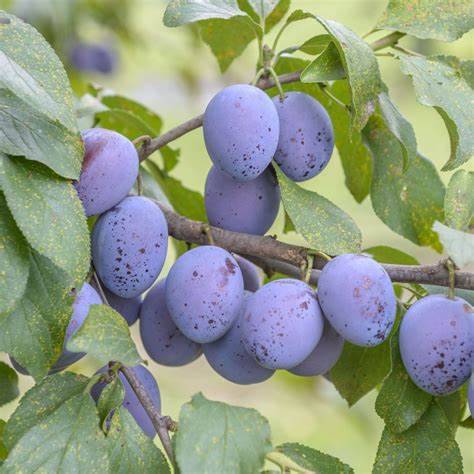
European plum
Prunus domestica
A small deciduous tree, usually 5–10 m, with dull oval finely toothed leaves, white blossom in early spring, and oval blue-black fruit carrying a waxy grey bloom over yellow-green flesh. The species is an ancient hybrid of blackthorn and cherry plum and is very variable — damsons, bullaces, gages and prune plums are all forms of it. For the kitchen the distinction matters less than the flesh: firm prune types such as 'Hauszwetsche' hold their shape when cooked and dry well, softer forms are better eaten raw.
Hedgerows, roadside verges, railway banks and the margins of old orchards, almost always where trees were once planted or discarded with garden waste; it suckers freely and can form thickets. Widespread through lowland Britain and Ireland, scarcer in the far north and at altitude.
The ripe flesh is edible raw and cooked. Kernels contain cyanogenic glycosides and should not be eaten in quantity, and unripe fruit is astringent and can loosen the bowels — as can a large quantity of ripe fruit. Hedgerow trees are usually relics of planting; trees in gardens and working orchards are someone's property, so ask before picking. Verge-side trees collect road dust and spray drift.
Always use more than one reference to confirm a plant. You are responsible for what you choose to forage.
Habit and bark
A single-stemmed or multi-stemmed tree to about 10 m with grey-brown fissured bark and a ring of suckers around the base. Larger and more tree-like than blackthorn, which is a dense shrub of a few metres with rigid side shoots.
Blossom
White five-petalled flowers, one or two from each bud on short stalks, opening as the leaves break in late March and April. Blackthorn flowers earlier and on bare wood, so a tree in flower with leaves already showing is not a sloe.
Leaves
Dull matt green, oval to elliptical, 5–10 cm long, finely toothed and downy on the underside, often folded upwards along the midrib. Cherry plum leaves are smaller, brighter and glossier.
Fruit
Oval rather than round, 3–5 cm long, blue-black to purple or sometimes yellow, with a waxy bloom that rubs off to a shine. Sloes are round and under 15 mm and dry the mouth sharply even when soft.
Stone
A flattened, slightly ridged stone that in prune-type plums such as 'Hauszwetsche' comes away cleanly from the flesh. A stone clinging tightly to the flesh points to a clingstone plum or gage rather than a prune type.
Updated 2026-08-08T11:13:24.078Z · Part of the shared Foragers Log catalogue · Fruit