European crabapple
Malus sylvestris
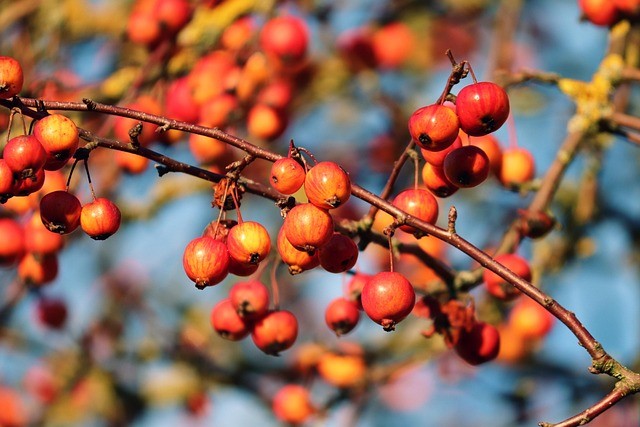
A small, often crooked tree of hedgerows and old woodland, with a dense twiggy crown and stiff, spine-tipped side shoots. The fruit is a hard yellow-green apple 2–4cm across, usually flushed red on the sunny side and far too sharp to eat raw. It is picked instead for jelly, verjuice, and for adding acid and pectin to cider. Many wild-looking apples in Britain are feral orchard seedlings; true crab has small, long-stalked fruit and near-hairless mature leaves.
Native to hedgerows, scrub and the edges of ancient woodland across Britain and Ireland, thinning out towards the far north of Scotland. Favours heavy, damp soils in good light, and usually stands as scattered single trees rather than in groups.
The flesh is safe but intensely sour and astringent, and is a cooking fruit rather than a raw one; large quantities raw can upset the stomach. The pips, as in all apples, contain cyanogenic compounds, so swallow them whole rather than chewing them by the handful. Mature trees carry sharp spine-tipped shoots, and hedgerow trees beside arable fields may have been sprayed.
Always use more than one reference to confirm a plant. You are responsible for what you choose to forage.
Habit and thorns
A low, crooked tree to about 10m with a dense, tangled crown, often standing alone in a hedge line. Many side shoots end in a stiff spine — a feature orchard apples almost always lack.
Fruit
Hard, roughly spherical apples 2–4cm across, yellow-green flushed red, with the dried sepals still attached at the tip. The stalk is slender and about as long as the fruit itself; short, thick stalks point to an orchard seedling.
Leaf underside
Oval, finely toothed leaves that are glossy above and effectively hairless beneath once mature. Rub a leaf between finger and thumb: persistent grey down underneath means a cultivated apple or a hybrid, not wild crab.
Blossom
White petals flushed pink on the outside, about 3–4cm across, opening in April and May before the tree fruits. Worth noting the tree in flower and returning in autumn, since crab apples are far easier to spot in blossom than in leaf.
Updated 2026-08-07T21:05:47.355Z · Part of the shared Foragers Log catalogue · Fruit