Cornelian cherry dogwood
Cornus mas
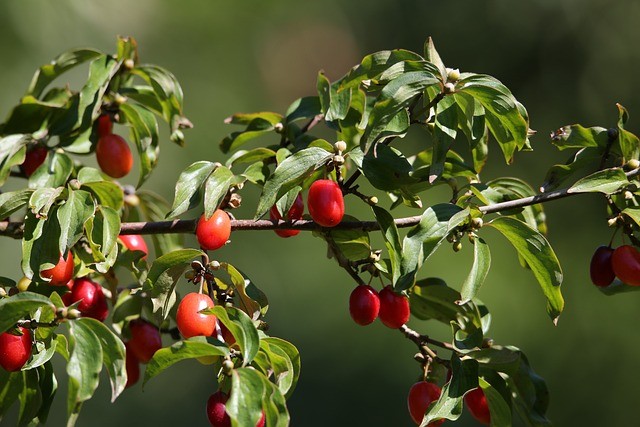
A spreading shrub or small tree reaching around 6 m, flowering in dense clusters of small yellow flowers on bare twigs long before the leaves appear, then carrying oblong crimson fruit through late summer. Each fruit holds a single elongated stone and tastes of sour cherry with a plum-like edge, harshly drying until fully soft. Widely planted in UK parks and gardens; the ripe fruit is used for jams, syrups and liqueurs.
Not native to Britain or Ireland. Planted in parks, large gardens, churchyards and amenity hedging, and occasionally self-sown close to planted trees. In its native central and southern European and western Asian range it grows in woodland edges and scrub on warm, lime-rich soils.
Ripe fruit is eaten raw or cooked; underripe fruit is harshly astringent and can unsettle the stomach in quantity, and the single hard stone is discarded. Common dogwood (Cornus sanguinea), often planted nearby, carries round black berries in flat-topped clusters rather than oblong red fruit, and its fruit is not eaten. Most UK trees are amenity plantings, so consider spraying and traffic.
Always use more than one reference to confirm a plant. You are responsible for what you choose to forage.
Fruit
Oblong drupe 15–20 mm long, glossy deep crimson, hanging singly or in twos on a slender stalk, with one long stone inside. The shape rules out the round black berries of common dogwood and the clustered translucent fruit of guelder-rose.
Winter flowering
Tight umbels of small four-petalled yellow flowers open on leafless twigs in late winter, well before any leaf. Nothing else of this size and habit in a UK park flowers so early with yellow on bare wood.
Leaves
Opposite, ovate and pointed, 4–10 cm, with fine hairs pressed flat against the surface and strongly curving veins. Torn slowly across, the veins draw out fine elastic white threads — a dogwood trait shared with other Cornus, so it confirms the genus rather than the species.
Habit and twigs
Multi-stemmed and densely twiggy, to about 6 m, with grey-brown bark flaking in small plates. Winter twigs are green-yellow, not the polished red of the ornamental dogwoods grown for winter stems.
Ripeness test
A fruit ready to pick gives under light pressure and pulls away without tearing the stalk. Firm, bright fruit is mouth-drying and worth leaving for a fortnight.
Updated 2026-08-07T20:41:46.001Z · Part of the shared Foragers Log catalogue · Fruit