Common whitebeam
Sorbus aria
A small to medium tree of chalk and limestone country, upright and oval-crowned, reaching around 15m. The leaves are simple, oval and sharply toothed, dark green above but covered beneath in dense white felt, so the whole crown flashes silver as wind turns them. Flat clusters of creamy-white flowers in May give way to speckled scarlet berries, mealy and harshly astringent until bletted, after which they are used for jellies and country wines.
Native on chalk and limestone in southern England, the Welsh borders and parts of Ireland — the Downs, Chilterns and Mendips especially — on woodland edges, scrub, cliff ledges and scree. Widely planted far beyond that range as a street, park and amenity tree, so most urban finds are planted stock.
Fresh berries are harshly astringent and can upset the stomach if eaten in quantity; they need bletting by frost or storage before use. The pips, like other pome seeds, contain cyanogenic compounds, so avoid crushing or chewing them. Several rare endemic whitebeam microspecies are legally protected, so be certain of the tree before picking, particularly in western Britain.
Always use more than one reference to confirm a plant. You are responsible for what you choose to forage.
Crown from a distance
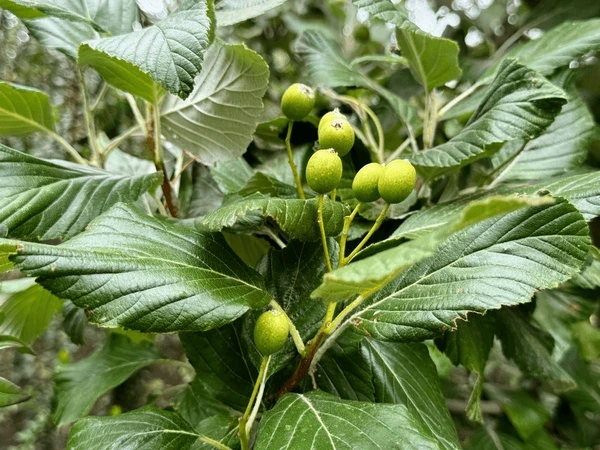
The undersides of the leaves are densely white-felted, so a breeze turns the whole crown silver-grey. This is the first thing to look for and it separates whitebeam from rowan and wild service tree at a hundred paces.
Leaf
Simple, oval to elliptical, 5–12cm, sharply and evenly toothed, on a short stalk. Not divided: rowan's leaves are pinnate with paired leaflets, and wild service's are cut into pointed maple-like lobes.
Leaf veins
Around 8–14 pairs of straight, parallel veins running from the midrib to the teeth, strongly impressed above and raised on the white underside. Run a thumb across the back of the leaf to feel them.
Flowers
Flat-topped corymbs of creamy-white five-petalled flowers in May, with the heavy scent typical of the hawthorn family, borne on a tree with simple leaves rather than a thorny shrub.
Berries
Rounded to slightly oval pomes 8–15mm across, scarlet to orange-red and freckled with pale lenticels, with dry mealy flesh. They hang in loose clusters into November and soften rather than shrivel after frost.
Updated 2026-08-07T20:46:16.833Z · Part of the shared Foragers Log catalogue · Herb