Common medlar
Mespilus germanica
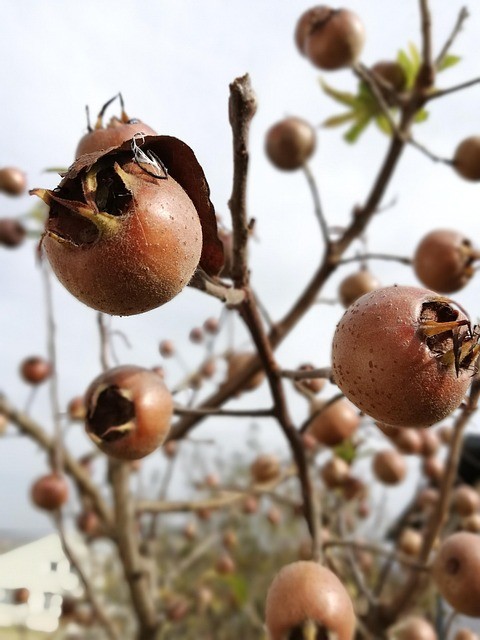
A low, crooked deciduous tree of the rose family, usually under 6 m and often broader than tall, with large solitary white flowers in late spring. The fruit is a dull russet-brown, 2–5 cm across, and ends in a wide open crown of persistent sepals that makes it look hollowed out at the tip. Picked hard in late autumn and left to blet until the flesh turns brown and pulpy, when it tastes of spiced apple and dates and is used for jelly, cheese and curd.
An old orchard and garden tree, long naturalised in Britain and Ireland and found in hedgerows, wood edges and rough ground near former plantings, mostly in southern and central England. Prefers deep, moist but free-draining soil in a sunny, sheltered spot.
Hard, acid and strongly mouth-drying until bletted; unbletted fruit is unpleasant rather than dangerous, though a quantity may upset the stomach. The pips are large and are not eaten — spit them out rather than crushing or chewing them. Wild-type trees in old hedges can carry stout thorns.
Always use more than one reference to confirm a plant. You are responsible for what you choose to forage.
Fruit with open calyx crown
Each fruit sits singly on a short shoot, russet-brown and 2–5 cm across, topped by a wide ring of five leafy sepals around a sunken hollow, so the end looks cut away. Hawthorn haws (Crataegus) are red, closed at the tip and roughly a fifth the size, and hang in clusters.
Flowers
Solitary white to faintly pink flowers 3–5 cm across in May and June, one at the end of each short leafy shoot. Hawthorn and blackthorn both carry small flowers in dense clusters, so a single large bloom on a hedgerow tree is decisive.
Leaves
Long and narrow, 6–15 cm, dull green above and softly hairy beneath, on a very short stalk and toothed only towards the tip. Unlike the deeply lobed leaf of hawthorn and broader in the middle than a plum leaf; they turn rich russet before falling.
Growth form and bark
A wide, low, twisting tree with spreading, often tangled branches and greyish-brown bark that cracks into small square plates on older trunks. Rarely reaches the upright form of a pear or apple.
Judging bletting
Freshly picked fruit is rock-hard and inedible. After two to four weeks in a cool, dry place the skin wrinkles and darkens and the flesh becomes soft, brown and sweet. Flesh that is grey-green, smells of alcohol or carries mould has gone past bletting into rot.
Updated 2026-08-07T20:57:56.022Z · Part of the shared Foragers Log catalogue · Fruit