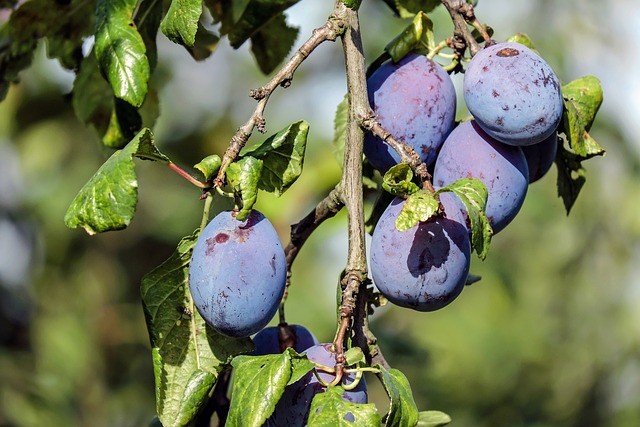
Bullace plum
Prunus domestica insititia
A small hedgerow tree or dense, semi-thorny shrub carrying round fruit about the size of a large marble, blue-black, purple or greenish-yellow under a waxy bloom. It is the same subspecies as the damson and is separated from it mainly by the rounder fruit rather than any firm botanical line. Sharp and faintly astringent raw, it is at its best cooked into jams, pies and steeped spirits.
Old hedgerows, scrub, wood edges and the remains of abandoned orchards on most soils. Long naturalised rather than truly native, so trees usually sit close to old field boundaries, lanes and settlement; frequent in England and Wales, scarcer north and west.
The flesh is edible, but the stones are not: kernels contain cyanogenic glycosides, so do not crack and eat them, and strain them out of preserves rather than leaving them to steep for months. Wild trees carry spine-tipped side shoots. Fruit from roadsides and sprayed field margins is best left.
Always use more than one reference to confirm a plant. You are responsible for what you choose to forage.
Fruit
Round to faintly oval, 20–30mm across, blue-black through purple to greenish-yellow with a dusty bloom. Clearly larger and rounder than a sloe, and smaller and blunter than a dessert plum such as Victoria.
Flowers
White, five-petalled, opening in April as the leaves break or just after. Blackthorn flowers earlier and on wholly bare twigs, so blossom timing separates the two before any fruit sets.
Twigs and thorns
Young shoots are finely downy and only some side shoots end in a short spine. A shrub armed with stiff spines along most twigs is blackthorn rather than this.
Stone
Rounded and gripping the flesh, so the fruit will not halve cleanly the way a freestone dessert plum does. Useful confirmation once the first fruit is opened.
Updated 2026-08-08T11:13:20.716Z · Part of the shared Foragers Log catalogue · Fruit