Blueberries
Vaccinium corymbosum
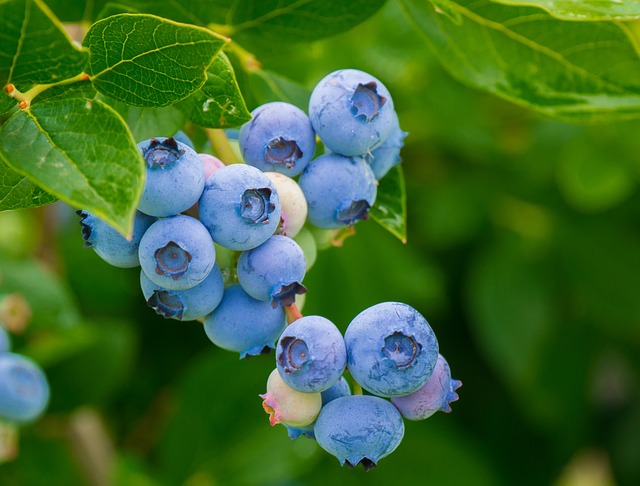
A twiggy, upright deciduous shrub, usually 1.5–3 m tall, with several woody stems from the base. Clusters of white to pink urn-shaped flowers hang from the previous year's wood in spring, followed by round blue-black berries with a grey waxy bloom and a small five-pointed crown at the tip. The flesh is pale green-white, so the juice does not stain. Grown commercially and in gardens across the UK, occasionally escaping onto acid ground; eaten raw, or cooked in pies, jams and cordials.
Native to eastern North America on acid, peaty and sandy soils. In the UK it is almost always a garden or fruit-farm plant, needing lime-free ground; escapes are occasional and usually short-lived, on damp acid heath, bog margins and open birch or pine woodland, mainly in southern England.
No toxicity concerns: the ripe fruit is eaten raw and grown commercially. When picking dark berries away from cultivation, be sure of the shrub — deadly nightshade (Atropa belladonna) carries solitary glossy black berries seated in a five-pointed green calyx star on a soft herbaceous stem, with no grey bloom and no puckered crown at the tip. Rinse fruit picked from bushes beside roads or field margins.
Always use more than one reference to confirm a plant. You are responsible for what you choose to forage.
Shrub shape and height
Upright and multi-stemmed, commonly 1.5–3 m tall, the older bark greyish and shredding. Visible from a distance as a bush rather than ground cover, which separates it at once from the low creeping wild Vaccinium species of UK heath and moor.
Berries in clusters with a crowned tip
Fruit hangs in loose bunches of five to ten, each berry 8–15 mm across, blue-black under a grey bloom that rubs off, with a small five-pointed calyx crown at the free end. Berries carried singly, or lacking that crown, mean a different plant.
Pale flesh
Cut or squash a ripe berry: the flesh and juice are pale green-white and will not stain fingers or teeth. Purple-staining juice indicates bilberry or one of the other dark-fleshed wild Vaccinium species.
Flowers
Short drooping racemes of white to pink urn-shaped flowers, 8–12 mm long, opening in May on wood made the previous year. Useful for confirming an escaped bush months before there is any fruit to check.
Leaves
Alternate, elliptical to oval, 3–8 cm long, untoothed or very finely toothed, dull blue-green above and turning red in autumn — noticeably larger and broader than the small bright leaves of bilberry.
Updated 2026-08-07T20:52:30.668Z · Part of the shared Foragers Log catalogue · Fruit