Asian pear
Pyrus pyrifolia
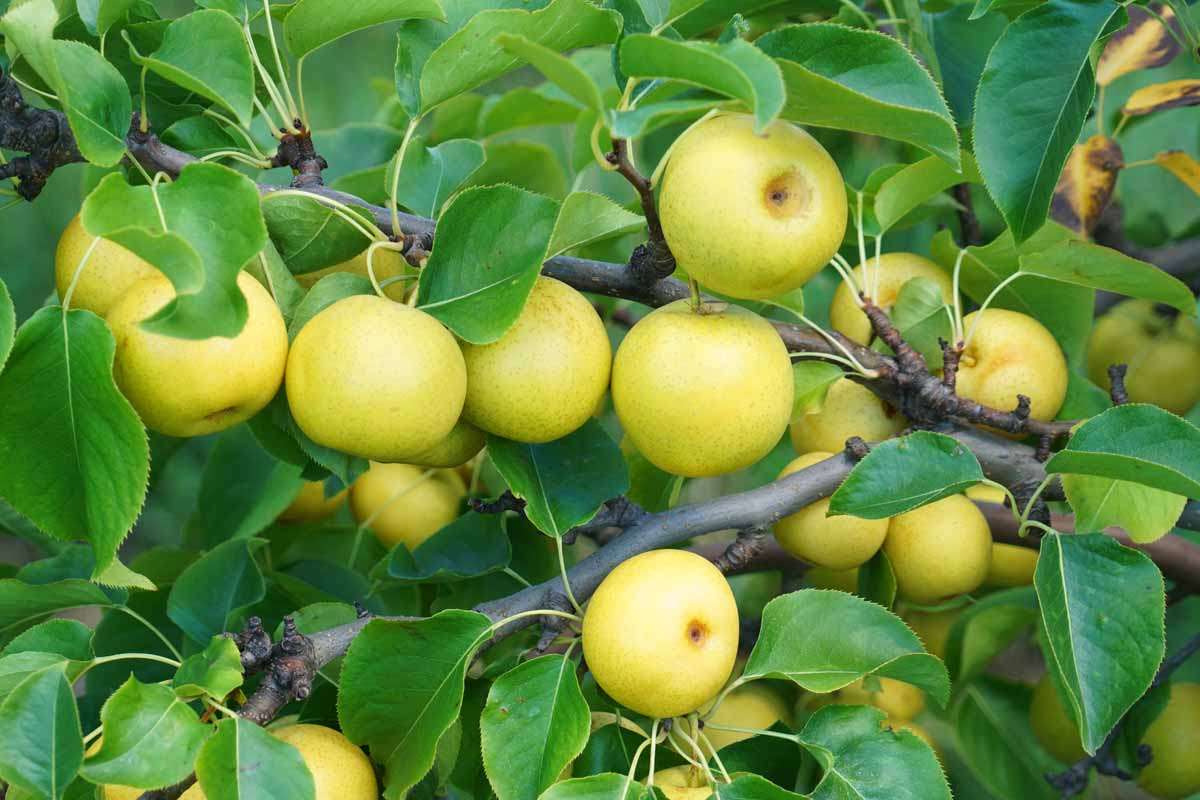
A small, spreading pear tree with glossy, finely toothed leaves and clusters of white spring blossom, bearing round apple-shaped fruit rather than the tapering pear shape. The skin is golden-brown and finely russeted in most cultivars, or smooth yellow-green in others. The flesh is very juicy, low in acid and stays crisp and slightly gritty instead of softening, so the fruit is picked ripe and eaten raw.
Native to warm temperate China, Japan and Korea; in Britain and Ireland it occurs only as a planted tree in gardens, allotments and a few small orchards, and is not naturalised. It wants deep soil, full sun and shelter, as the early blossom is easily caught by frost.
The ripe flesh is eaten raw with no preparation needed, and there is no toxic UK tree fruit of comparable size and shape. As with other Rosaceae, the pips contain cyanogenic compounds and are not worth chewing in quantity. Wash fruit from roadside or sprayed orchard trees, and treat windfalls with care as they draw wasps.
Always use more than one reference to confirm a plant. You are responsible for what you choose to forage.
Fruit shape and skin
Round to slightly flattened and apple-like, 6–10cm across, with no neck at all. That squat outline rules out European pear cultivars, which taper towards the stalk even when short and squat.
Flesh and ripeness test
Flesh is white, very juicy and crisp with gritty stone cells, and it never softens. Judge ripeness by skin colour and by the fruit parting easily from the spur, not by pressing the neck as you would a European pear.
Leaves
Glossy, oval to oblong, up to about 12cm long, tapering to a fine point, with small forward-pointing bristle-tipped teeth along the margin. European pear leaves are shorter, duller and much more bluntly toothed or almost entire.
Blossom
White five-petalled flowers in tight clusters, opening in early to mid spring as the leaves expand. Apple blossom in the same orchard is pink-flushed in bud and opens later, so a tree in full white flower early in the season is worth returning to in autumn.
Updated 2026-08-07T20:52:33.626Z · Part of the shared Foragers Log catalogue · Fruit