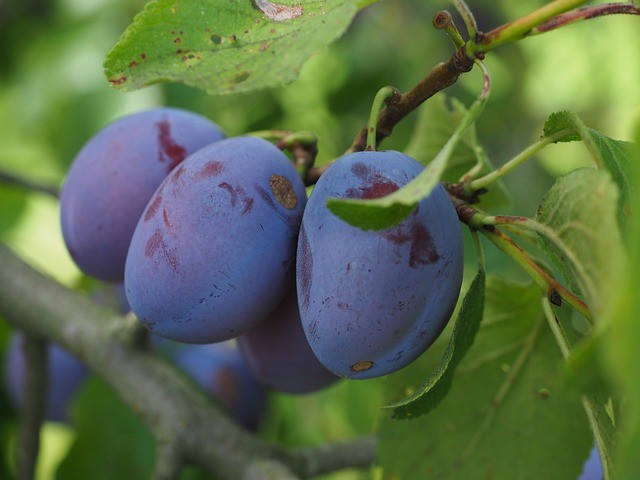
Victoria plum
Prunus domestica
A cultivated European plum grown for large oval fruit, gold beneath a red-purple flush and a soft bloom, with sweet golden flesh that parts cleanly from the stone. Raised in Sussex and introduced in the nineteenth century, it is the most widely planted plum in Britain and turns up self-sown in hedges and on rough ground. Eaten fresh, or cooked for jam, chutney and puddings.
Not a wild plant: planted in gardens, allotments and old orchards, and self-seeded from discarded stones into hedgerows, railway banks and waste ground. Tolerant of most soils and common through lowland Britain and Ireland, but poor in exposed uplands.
The flesh is a plain edible fruit; the stones are not — plum kernels contain cyanogenic compounds and should not be eaten or crushed into preserves. A large quantity of ripe fruit at once can loosen the bowels, windfalls draw wasps, and trees in gardens and commercial orchards may have been sprayed.
Always use more than one reference to confirm a plant. You are responsible for what you choose to forage.
Fruit
Oval and 4–5 cm long, yellow-gold flushed and speckled dull red to purple, with a shallow groove down one side. Much larger and more elongated than the round, cherry-sized yellow fruit of a Mirabelle, and never the uniform blue-black of a damson.
Flesh and stone
Ripe flesh is deep golden-yellow and freestone: the flattened, pitted stone lifts out of a halved fruit with almost no flesh clinging to it. Fruit that has to be cut away from the stone is a different cultivar.
Leaves
Matt mid-green, broadest above the middle, 5–10 cm long, bluntly toothed and softly downy on the underside. Cherries growing in the same hedge have glossier, more sharply pointed leaves.
Twigs and flowers
White five-petalled flowers open in clusters of two or three in late March and April, with or just before the leaves. Twigs end in a bud, not a spine — blackthorn, which flowers earlier on bare wood, has stiff spine-tipped side shoots.
Habit
A small tree to about 5 m with grey-brown fissured bark, often with a graft union swelling low on the trunk where it was budded onto a rootstock. Trees grown from a dropped stone will not come true to the cultivar.
Updated 2026-08-08T11:13:22.540Z · Part of the shared Foragers Log catalogue · Fruit