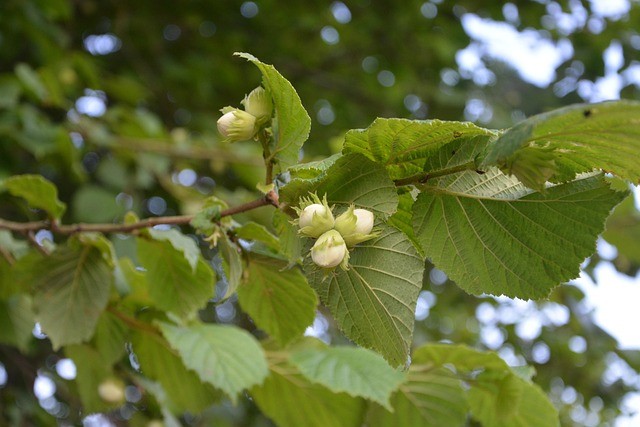
Turkish hazel
Corylus colurna
A large, strikingly conical tree to 20 m or more, with a single straight trunk and pale grey bark broken into corky, flaking plates. The leaves are broad, doubly toothed and heart-shaped at the base, much like common hazel's but larger. Nuts ripen in tight clusters of three to six, each enclosed in a deeply cut, bristly husk with long fringed lobes; the kernel is sweet and hazelnut-flavoured but small inside a very thick, hard shell.
Not native to Britain or Ireland. Native to south-east Europe and south-west Asia, and planted here as a street, car park and parkland tree for its tidy conical shape and tolerance of compacted soil and pollution. Rarely self-sown.
The nuts carry the same allergen risk as any hazelnut and should be avoided by anyone with a tree nut allergy. Shells are thick enough to need a proper cracker rather than thumb pressure. Most UK trees stand on streets and car parks, so consider vehicle exhaust and amenity spraying, and check whether the tree is on land where gathering is permitted.
Always use more than one reference to confirm a plant. You are responsible for what you choose to forage.
Crown and trunk
A neat, narrowly conical to pyramidal crown on one straight central trunk, visible from across a car park. Common hazel is a multi-stemmed suckering shrub or small tree with no leading stem, so growth form alone separates them before you look at a single leaf.
Bark
Pale greyish-buff and corky, breaking into small squarish flaking plates on older trunks. Common hazel bark stays smooth, shiny and coppery-brown with horizontal lenticels.
Husk
Each nut sits in a thick green husk cut into long, narrow, out-turned and bristly lobes, so a ripe cluster looks shaggy and star-like. Common hazel husks are shorter, smoother and only shallowly ragged at the rim.
Nut and kernel
Nuts are slightly flattened and angular with a very thick shell; the kernel inside is noticeably smaller than a cultivated hazelnut for the same overall size. Expect a low yield of kernel for the effort of cracking.
Leaves
Broad, rounded, heart-shaped at the base and doubly toothed, on a hairy stalk, and larger than common hazel's. Alder leaves in similar planted settings are blunt or notched at the tip and never softly hairy beneath.
Updated 2026-08-07T20:37:36.638Z · Part of the shared Foragers Log catalogue · Other