Sweet Potato
Ipomoea batatas
A frost-tender trailing perennial of the bindweed family, grown for its swollen underground storage roots rather than for stem or seed. The vines creep and twine, rooting where they touch soil, and carry heart-shaped to deeply lobed leaves on long stalks. Roots are tapered and smooth-skinned, orange, cream or purple within. Despite the name it is unrelated to the potato.
Not a wild plant in Britain or Ireland. A cultivated crop of tropical American origin needing warmth and a long season, usually grown from slips in free-draining sandy soil under fleece, cloches or a polytunnel. It is killed by frost and does not naturalise here.
Roots and young shoots are eaten cooked rather than raw. Discard any root with sunken dark rot patches or mould: spoilage fungi produce ipomoeamarone and related compounds that cooking does not destroy. The roots are fairly high in oxalate, worth noting for anyone advised to limit it.
Always use more than one reference to confirm a plant. You are responsible for what you choose to forage.
Growth habit
Long trailing or twining vines that spread across the ground and root at the nodes, forming dense low cover rather than an upright bushy plant. In a UK season the top growth rarely flowers.
Leaves
Alternate, heart-shaped to palmately three- or five-lobed, on distinct long stalks. Leaf shape varies considerably between cultivars, so it is not a reliable way to tell one variety from another.
Storage roots
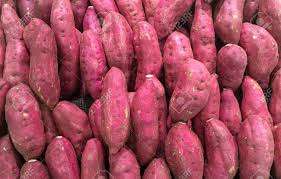
Swollen tapered roots with smooth skin and no eyes or buds on the surface, unlike a potato tuber, which is a stem and carries eyes that sprout. Flesh may be orange, cream, yellow or deep purple.
Flowers
Funnel-shaped, pink to pale purple with a darker throat, typical of the bindweeds and morning glories. Produced only in hot summers or under cover in Britain, so most crops are identified by foliage and root alone.
Updated 2026-08-08T12:02:58.807Z · Part of the shared Foragers Log catalogue · Vegetable