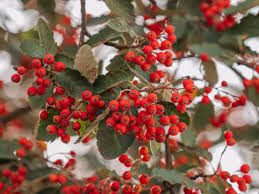
Swedish whitebeam
Sorbus intermedia
Eating this will make you ill. Listed here so you can recognise and avoid it.
A medium-sized tree of streets, car parks and shelter belts, with a dense oval crown. The leaves are single blades, dark glossy green above and thickly white-felted beneath, cut into shallow triangular lobes towards the base, so the whole crown flickers pale when wind turns them. Flat heads of white flowers in May are followed by dense clusters of orange-red, mealy pomes. Scandinavian in origin and apomictic, so seedlings come true; the fruit is normally cooked into jellies rather than eaten from the tree.
Native to southern Sweden, the Baltic and adjacent coasts. In Britain and Ireland almost always a planted tree — roadside verges, housing estates, retail car parks and windbreaks — and increasingly naturalised from bird-sown seed on railway banks, waste ground and scrub edges. Tolerant of compacted urban soil, salt spray and exposure.
Raw fruit is astringent and contains parasorbic acid; eaten in quantity it can cause nausea and stomach upset. Cooking, or picking after the first hard frosts, breaks this down. Don't chew or grind the seeds, which hold cyanogenic glycosides. Most accessible trees stand on roadsides and amenity land, so weigh traffic grime and municipal spraying before picking.
Always use more than one reference to confirm a plant. You are responsible for what you choose to forage.
Leaf
One undivided blade 7–12 cm long, shallowly lobed in the lower half and merely toothed towards the tip, on a clear stalk. The underside is covered in dense grey-white felt that rubs off on a finger — a rowan leaf, by contrast, is cut right to the midrib into separate leaflets.
Crown from a distance
A compact, rather formal oval crown that looks two-toned in wind as the white leaf undersides turn. This flicker is the quickest way to pick the tree out along a road from a car park's worth of planted limes and maples.
Flowers
Flat-topped corymbs of five-petalled white flowers 1–2 cm across in May, with a heavy, slightly sour scent. The flower heads sit above the leaves and are followed by fruit in the same arrangement.
Fruit
Orange-red to scarlet pomes 12–15 mm long, slightly longer than wide, in hanging clusters. The flesh is dry and mealy rather than juicy, and each holds two to four flat seeds — not the single stone of a cherry or sloe.
Bark and twigs
Smooth grey bark on young trees, becoming shallowly fissured with age; buds are green-brown, blunt and slightly hairy, not the large purple-black sticky buds of rowan.
Updated 2026-08-07T21:15:32.755Z · Part of the shared Foragers Log catalogue · Fruit