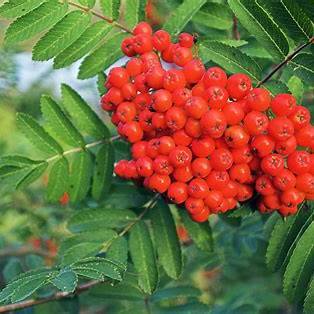
European rowan
Sorbus aucuparia
Eating this will make you ill. Listed here so you can recognise and avoid it.
A slender tree of high ground, with pinnate leaves of nine to nineteen toothed leaflets, flat creamy blossom in May and dense drooping bunches of orange-red pomes from late summer. Each berry carries a tiny five-pointed calyx eye, as an apple does. Far too bitter and astringent to enjoy raw, but cooked with sugar and a high-pectin fruit it makes a sharp jelly traditionally served with game, and it is also used in country wines.
Widespread through Britain and Ireland on poor, acid soils: moorland edges, crags and gullies, birch and oak woodland, and rocky ground well above the tree line of most broadleaves. Also planted heavily in streets, parks and gardens.
Raw berries contain parasorbic acid and can cause nausea, vomiting and stomach cramps if eaten in any quantity; cooking, or a spell in the freezer, converts it to harmless sorbic acid. Avoid crushing and swallowing large amounts of seed, which is cyanogenic. Street and verge trees carry the usual roadside pollution caution.
Always use more than one reference to confirm a plant. You are responsible for what you choose to forage.
Leaves
Pinnate, with nine to nineteen narrow leaflets, each toothed along almost its whole length and sitting stalkless on the central rib. Ash, the other common pinnate tree, has fewer leaflets with much shallower or no teeth and stout black winter buds.
Berries
Round, roughly 8mm, orange-red to scarlet, hanging in heavy branched clusters from late summer. Look at the tip of a single berry: the little five-pointed calyx scar shows it is a miniature pome, not a berry with a stone.
Bark and form
A narrow, open-crowned tree rarely much over 15m, with smooth silvery-grey bark marked by horizontal lenticels. On crags it often grows out of a rock crevice with a leaning, wind-shaped trunk.
Flowers
Dense flat-topped heads of small creamy-white five-petalled flowers in May, with a heavy, faintly rank smell. Hawthorn flowers earlier and carries thorns; rowan twigs are unarmed.
Updated 2026-08-07T20:57:52.124Z · Part of the shared Foragers Log catalogue · Fruit