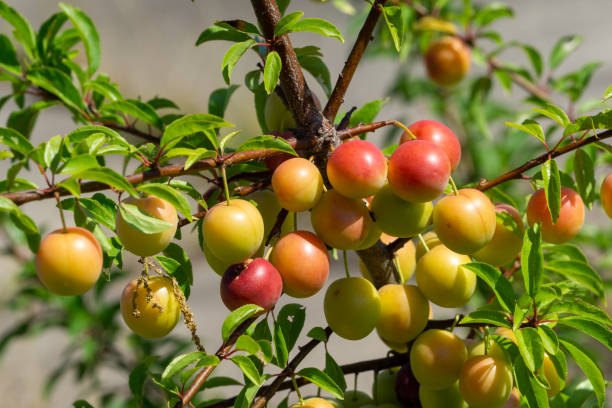
Greengage plum
Prunus domestica italica
A small, round dessert plum, green to greenish-gold when ripe and often carrying a warm amber flush on the sunny side, with firm honeyed flesh and a stone that clings to it. Greengages are the Reine Claude group within Prunus domestica rather than a wild species, so trees found out in the open are almost always old garden or orchard plantings that have persisted or suckered. Eaten fresh, or cooked into jam and tarts.
A cultivated tree, not native: gardens, old orchards and orchard remnants, occasionally persisting in hedgerows, on verges and along field edges where a planting has suckered or a discarded stone has taken. Commonest in southern and eastern England on sheltered, sunny, free-draining sites.
The ripe flesh is eaten raw and nothing in the cultivated plum group is dangerously toxic. Do not crack and eat the kernels; like other Prunus stones they contain amygdalin. Underripe fruit is sharp and loosening, and so is a large quantity of ripe fruit. Windfalls in late summer attract wasps, so check fruit before picking by hand.
Always use more than one reference to confirm a plant. You are responsible for what you choose to forage.
Fruit colour and shape
Round to slightly oval, 2–4 cm across, staying green to greenish-gold at full ripeness with at most an amber blush. It never darkens to the blue-black of a sloe or the deep purple-red of a Victoria plum, so a green fruit on a plum tree in late August is not necessarily unripe.
Bloom on the skin
A fine grey-white waxy bloom covers the fruit and rubs away under a thumb to a slightly translucent green skin. Fruit with the bloom intact has not been handled or rain-battered and keeps better.
Stone
Flattened, oval and clinging tightly to the flesh, so the halves do not twist apart cleanly the way a freestone plum does. Expect to cut the flesh off the stone when preparing them.
Leaves and twigs
Matt, dull green leaves, broadest above the middle, with slightly downy undersides and a short leaf stalk. Twigs are essentially thornless, which separates a suckering greengage in a hedge from blackthorn, whose side shoots end in stiff spines.
Habit of the tree
A modest, often untidy tree to around 5 m, usually grafted and frequently ringed by suckers from the rootstock. Suckers carry the rootstock's leaves and fruit, not the greengage's, so fruit taken from them may be quite different.
Updated 2026-08-08T11:13:23.259Z · Part of the shared Foragers Log catalogue · Fruit