Conference Pear
Pyrus communis
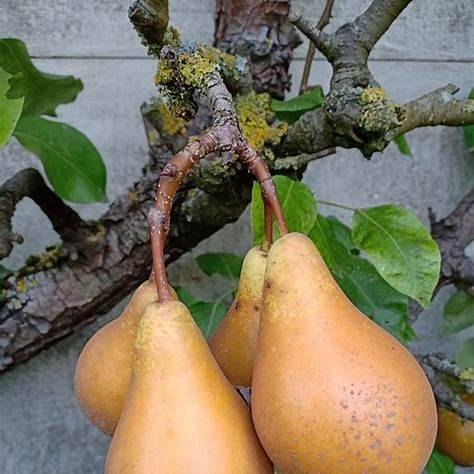
A cultivar of the common pear, raised at the Rivers nursery in Hertfordshire in the 1880s and now the pear most often met with in British gardens, hedgerow plantings and neglected orchards. The fruit is long and bottle-shaped with a narrow curving neck, the thin green skin ripening to yellowish bronze under a rough tan russet that spreads out from the stalk. Picked firm and ripened indoors, the flesh becomes pale cream, soft and sweet; left on the tree it tends to brown at the core.
Not a wild native. Grown in gardens, allotments and commercial orchards, and persisting on old orchard sites, in hedgerows and on railway and roadside land where trees have been planted or left. Usually grafted on quince rootstock, so a modest tree rather than a full standard. Commonest in lowland England, less reliable in northern Britain and Scotland.
The flesh is safe raw and cooked. Pips, like those of other pome and stone fruit, contain small amounts of amygdalin, so avoid chewing them in quantity; pears are also high in sorbitol and a large helping can loosen the bowels. Trees on verges and field edges may carry traffic grime or spray drift, and orchard trees usually have an owner — ask before picking.
Always use more than one reference to confirm a plant. You are responsible for what you choose to forage.
Fruit shape
Long and bottle-shaped, with a distinctly narrow neck curving into a squat base. A rounded, neckless pear with no taper is a different cultivar; wild pear fruit is small, round and hard.
Skin and russet
Green ripening to yellow-bronze, with a rough tan russet spreading from the stalk end over much of the fruit. Smooth, unblemished skin points to another dessert cultivar rather than this one.
Leaves and shoots
Glossy oval leaves with finely toothed margins on long stalks, carried on thornless shoots. Wild pear (Pyrus pyraster) typically bears stiff spine-tipped short shoots, and apple leaves are duller and downy beneath.
Blossom
White five-petalled flowers in tight clusters with dark red-purple anthers, opening in April a little ahead of apple blossom, which shows pink buds and yellow anthers.
Ripeness test
Test at the shoulder beside the stalk, which softens first; a pear soft all over has usually already gone mealy inside. Fruit is picked firm and ripened off the tree rather than left to soften on it.
Updated 2026-08-07T20:57:44.475Z · Part of the shared Foragers Log catalogue · Fruit