Common fig
Ficus carica
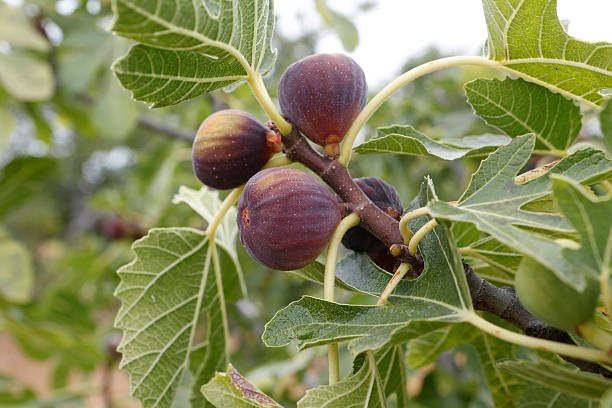
A deciduous shrub or low-branched small tree with thick, sandpapery leaves cut into three to five deep lobes, and smooth grey bark on stout greenish shoots. What looks like the fruit is a hollow fleshy receptacle holding the flowers inside, ripening from green to brown or purple and softening until it droops. Eaten fresh, dried or cooked once fully soft.
Long grown against warm south- and west-facing walls, and naturalised well beyond gardens: self-sown on riverbanks, canal and bridge walls, railway sidings and urban waste ground, most persistently in southern England and in warm city centres. Tolerates poor, dry, alkaline rubble.
Ripe figs are safe to eat. The milky latex in leaves, stems and unripe fruit contains furanocoumarins and can blister skin that is then exposed to sunlight, so cover your arms when picking in quantity and rinse sap off promptly. Unripe figs are astringent and irritate the mouth. Urban self-sown trees often stand on roadsides and rubble, so wash the fruit.
Always use more than one reference to confirm a plant. You are responsible for what you choose to forage.
Growth form and bark
Usually a broad multi-stemmed shrub or squat tree, often leaning out from a wall it was planted against. Bark is smooth and pale grey, and the current year's shoots are thick, blunt-tipped and distinctly greenish rather than twiggy.
Leaves
Large, thick and rough as fine sandpaper, palmately cut into three to five broad blunt lobes on a long stalk. No other tree or shrub in a British hedgerow or on waste ground carries a leaf of this size and shape.
Fruit shape and ripeness
Pear-shaped and borne singly in the leaf axils, with a small eye (the ostiole) at the broad end. Ripe figs give to gentle pressure, bend downwards on the stalk and may split slightly; a fig still held stiffly upright is unripe whatever its colour.
Overwintering embryo figs
Pea-sized figs sit at the shoot tips through winter and are the ones that ripen the following summer in Britain. Figs set on new spring growth rarely ripen outdoors here and stay hard and green into autumn.
White latex (crush test)
A snapped leaf stalk or a picked unripe fig bleeds sticky white sap. Mulberries share this milky sap, but the fig's deeply lobed sandpapery leaves and single pear-shaped fruit separate it from the mulberry's cluster of small drupelets.
Wall-base habit
Self-sown plants often root in mortar joints, bridge abutments and river walls, growing hard against masonry with roots confined to rubble — a siting that suits the species and helps confirm it in towns.
Updated 2026-08-07T21:15:25.405Z · Part of the shared Foragers Log catalogue · Fruit