Black walnut
Juglans nigra
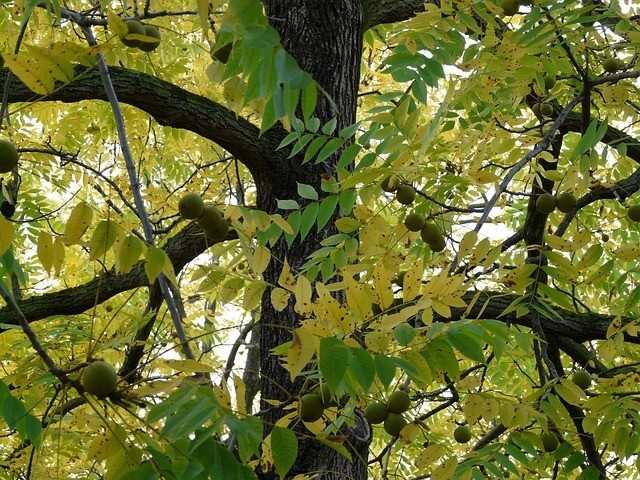
A large deciduous tree with dark, deeply furrowed bark and long alternate pinnate leaves carrying 15–23 narrow, finely toothed leaflets, the end leaflet often small or missing. The fruit is a solid green globe about 5 cm across that never splits open, enclosing a thick, deeply corrugated shell and a rich, strongly flavoured kernel. Planted in Britain rather than native, and cropping well only after a warm summer.
Planted, not native: parks, large gardens, arboreta and estate parkland, chiefly in southern and eastern England where summers are warm enough to ripen a crop. Favours deep, moist, well-drained soil in full sun, and rarely regenerates away from planting.
The kernels are edible raw or roasted, but the green husks are rich in juglone, which stains skin and clothing brown for weeks and irritates some people, so hull them in gloves. Discard nuts whose husks have gone black and soft. Most British trees stand in parks and private collections, so ask before gathering.
Always use more than one reference to confirm a plant. You are responsible for what you choose to forage.
Leaves
Alternate and 30–60 cm long, with 15–23 narrow, finely toothed leaflets and often no terminal leaflet at all. Ash leaves are also pinnate but sit in opposite pairs on the twig.
Fruit husk
A round, solid green husk 4–6 cm across that stays whole on the tree and blackens as it rots on the ground. A husk that has split cleanly along a seam is not this tree.
Bark
Dark grey-brown and deeply furrowed into a narrow diamond network, visible from some distance and darker than the pale grey, more shallowly fissured bark of common walnut.
Shell
Extremely hard, thick and deeply corrugated, needing a vice or hammer, with the kernel held in tight lobes. Shells that part into two clean halves under hand pressure belong to another walnut.
Crush test
Crushed leaves and green husks give a sharp, spicy, resinous smell, and a fresh husk rubbed on the palm stains it yellow-brown within minutes. No stain and no scent means you have the wrong tree.
Updated 2026-08-07T20:37:41.430Z · Part of the shared Foragers Log catalogue · Other