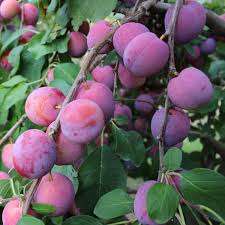
Avalon plum
Prunus domestica
A modern English dessert plum, raised at Long Ashton Research Station near Bristol, grown for its large oval fruit — dark red to purple over a yellow ground, with a light bloom and golden, juicy flesh. Trees are vigorous and crop heavily, ripening in the second half of August, a little after Victoria. Best eaten fresh, though it also cooks and preserves well.
Not a wild plant: grafted onto a plum rootstock and planted in gardens, allotments and orchards, wanting deep, moist but well-drained soil and a sunny, sheltered position. Relic and seedling plums persist in hedgerows and on old orchard ground across lowland Britain and Ireland, but named cultivars do not come true from seed.
Ripe flesh is a straightforward food. The kernel inside the stone contains amygdalin and should not be cracked or chewed; discard stones. Quantities of underripe fruit can loosen the bowels. Wasps tunnel into ripening plums, so check fruit before biting, and assume garden or orchard trees may have been sprayed.
Always use more than one reference to confirm a plant. You are responsible for what you choose to forage.
Fruit
Large, oval to slightly oblong dessert plum, roughly 45–50 mm long, dark red flushing to purple over a yellow ground and covered with a fine pale bloom that rubs off under the thumb. Darker and heavier-cropping than Victoria, whose fruit stays a paler pink-red.
Flesh and stone
Cut lengthways the flesh is deep golden and juicy, sweet with a mild acidity, and parts fairly cleanly from the stone. The stone itself is flattened and ridged along one edge — keep it out of jam pans and preserves rather than crushing it.
Leaves
Obovate, dull matt green, bluntly toothed and slightly downy on the underside, held on a short stalk. The matt surface is the quick check that separates plum foliage from the glossy, longer-pointed leaves of cherries growing in the same garden.
Flowers
White, five-petalled, about 20 mm across, in small clusters of two or three on shoots made the previous year, opening late March to April before the leaves are fully out.
Twigs and habit
A grafted tree with a clear graft union near the base and smooth, thornless twigs. Thornless growth distinguishes a cultivated plum from the spine-tipped shoots of blackthorn or cherry plum, which produce much smaller fruit.
Updated 2026-08-08T11:13:19.946Z · Part of the shared Foragers Log catalogue · Fruit