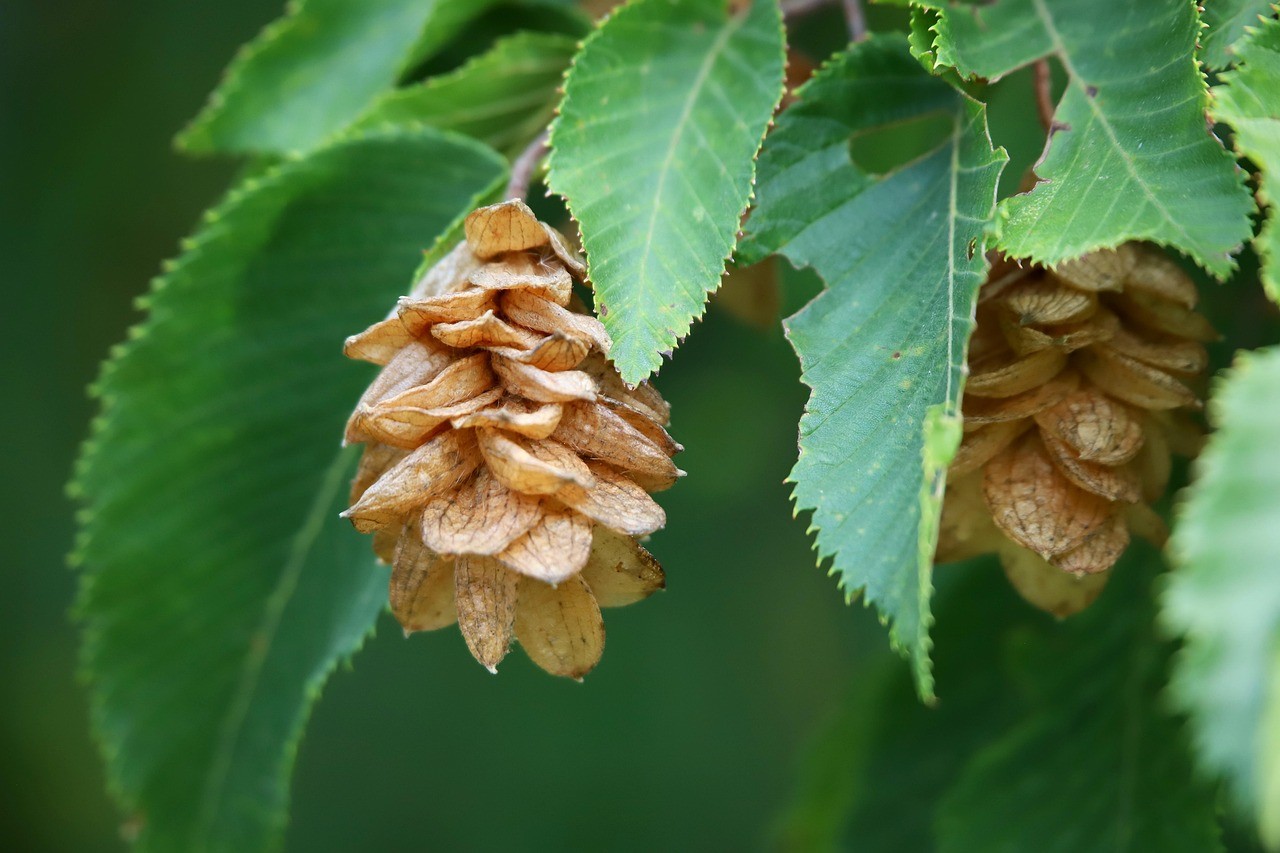
American hornbeam
Carpinus caroliniana
A small, slow-growing deciduous tree of eastern North America, grown in Britain as an ornamental. The trunk is smooth and grey but sinuously fluted, as though muscled, and the leaves are neatly oval, sharply pointed and doubly toothed. Seed hangs in drooping catkins of loose, papery bracts, each bract holding a single small ribbed nutlet. The kernels are edible but tiny, and gathering enough to be worth shelling takes patience.
In its native range an understorey tree of damp woodland, stream banks and river terraces. In Britain and Ireland it is not naturalised, so expect it only where planted: arboreta, botanic gardens, larger parks and occasional street and car-park schemes on moist but drained soil.
No eating toxicity is recorded for the nutlets or the young leaves, but the yield is very small and the shells need cracking, so this is a curiosity rather than a food source. Almost every British tree is a planted specimen, often labelled and part of a collection, so ask before taking shoots or catkins; roadside and car-park plantings carry the usual traffic residues.
Always use more than one reference to confirm a plant. You are responsible for what you choose to forage.
Trunk and bark
Smooth blue-grey bark over a trunk that is deeply fluted and rippled, so the stem looks like a flexed muscle. Visible at a distance and the quickest way to pick the tree out of a mixed planting.
Leaves
Oval, 5–12 cm, drawn to a fine point, with sharp double toothing and straight parallel veins running to the margin. Thinner and more finely toothed than the leaves of most planted hornbeams, turning orange to deep red in autumn.
Fruiting catkin
A slack, drooping chain of pale green leafy bracts, each with a single hard ribbed nutlet at its base. Pull one bract away and the nutlet sits at the very bottom, about the size of a peppercorn.
Twigs and buds
Slender, zig-zagging twigs with small, closely pressed buds only 2–3 mm long, reddish-brown and blunt. Useful in winter, when bark and buds are all that is left to work from.
Updated 2026-08-07T20:52:25.486Z · Part of the shared Foragers Log catalogue · Fruit