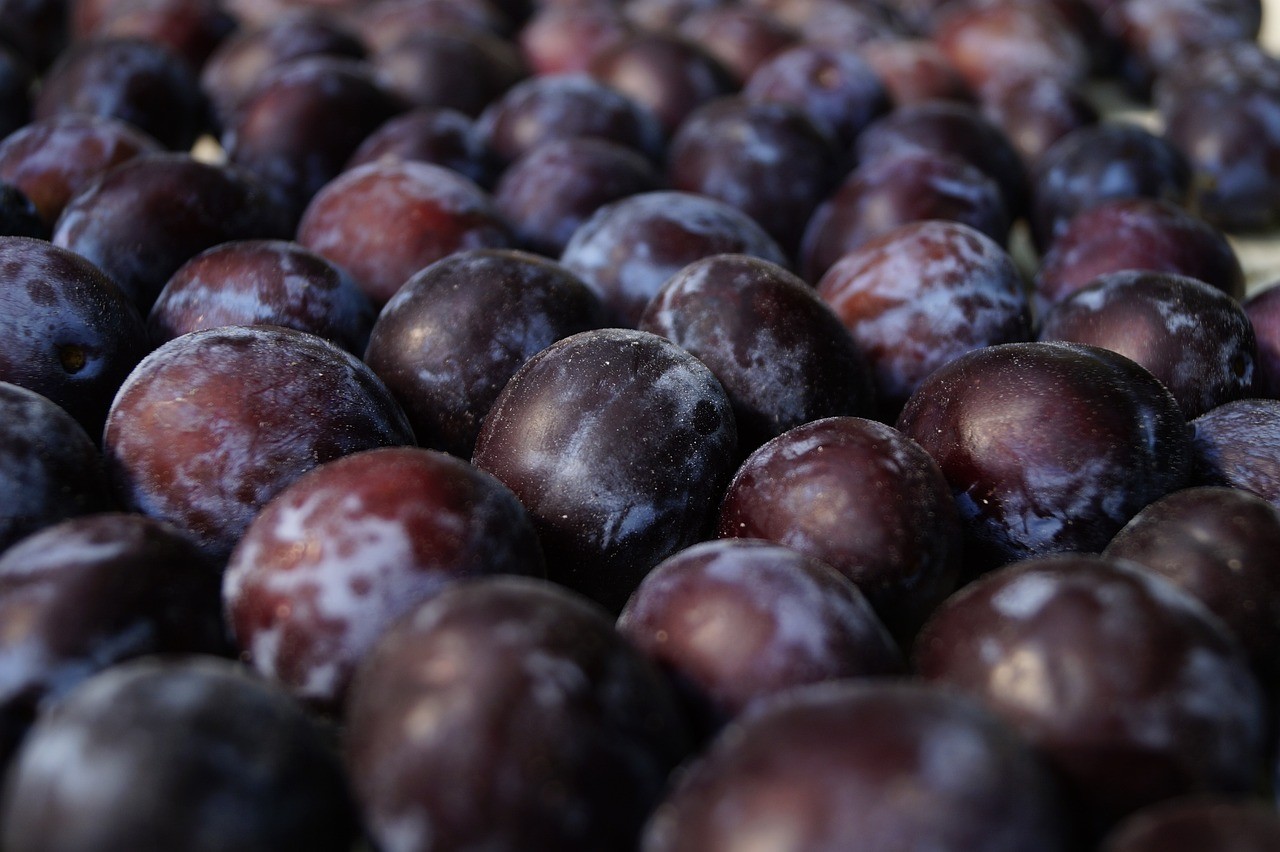
Alderman plum
Prunus domestica
A garden plum grown mainly for eating fresh: a small, spreading tree bearing large, deep red-purple fruit with a pale waxy bloom and amber-yellow flesh in late summer. Trees of named cultivars are grafted, not grown from stones, so they appear in gardens and orchards rather than as genuinely wild plants. Its parentage is unsettled — some sources treat it as a European plum, others as an Asian-American hybrid — but the fruit is picked and used the same way either way.
Planted rather than wild: gardens, allotments, community orchards and occasional hedgerow plantings throughout Britain and Ireland, on deep, well-drained soil in full sun. Rootstock suckers and self-sown seedlings persist around old trees, though seedlings rarely carry fruit like the parent.
The ripe flesh is a straightforward edible fruit. Stone kernels contain cyanogenic compounds, so stone the fruit and discard the kernels rather than cracking and eating them. Quantities of under-ripe fruit can loosen the bowels. Ripe plums draw wasps that crawl into splits, so check each fruit before picking or biting, and note that garden and orchard trees may have been sprayed and always belong to someone.
Always use more than one reference to confirm a plant. You are responsible for what you choose to forage.
Tree form and graft union
A small, open-crowned tree, usually 3–5 m on a garden rootstock, with greyish, slightly fissured bark. A swollen graft union low on the trunk, and suckers rising from below it, mark it as a planted cultivar rather than a wild plum.
Blossom
White, five-petalled flowers about 2 cm across, carried in small clusters on short spurs in spring as the leaves begin to break. Flowering is on the previous year's wood, so blossom appears along the length of older twigs rather than only at the tips.
Leaves and twigs
Oval to obovate leaves with fine, blunt teeth, dull matte green and often slightly folded along the midrib. Twigs are unarmed — no spine-tipped side shoots, which separates any cultivated plum from blackthorn.
Fruit and stone
Large for a plum, roundish to slightly oval, deep red to purple under a dusty bloom, with amber-yellow flesh. A single flattened stone sits at the centre; on a hand-picked fruit the flesh should smell sweet at the stalk end, and any fruit already split or weeping is best left.
Updated 2026-08-08T11:13:19.266Z · Part of the shared Foragers Log catalogue · Fruit