Wallpepper
Sedum acre
Eating this will make you ill. Listed here so you can recognise and avoid it.
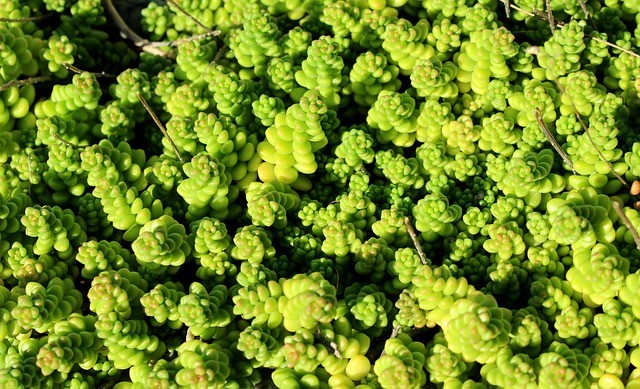
A low, mat-forming succulent of bare stone and thin soil, seldom more than 10 cm tall, with creeping shoots crowded in tiny fleshy leaves 3–5 mm long and bright yellow five-petalled star flowers in early summer. Chewed, the leaves give a sharp peppery burn, which is where the name comes from and why it was once used very sparingly as a pepper substitute. Better treated as an identification exercise than as food, since the same compounds that carry the heat also irritate the gut.
Shallow, dry, well-drained ground: old walls and mortar, roof tiles, shingle, sand dunes, limestone outcrops, railway ballast and gravel car parks. Native and widespread across Britain and Ireland, commonest on lime-rich or coastal ground.
Sharply acrid rather than pleasantly hot. The leaves contain piperidine alkaloids, and more than a taste can cause burning of the mouth, vomiting and diarrhoea; the sap irritates some people's skin. It is also easy to take for reflexed stonecrop (Sedum rupestre), the milder stonecrop more often eaten, which has longer pointed blue-green leaves of 8–20 mm and none of the peppery burn.
Always use more than one reference to confirm a plant. You are responsible for what you choose to forage.
Growth habit
Forms a flat, dense evergreen mat over bare stone or gravel, the creeping stems rooting as they spread and flowering shoots standing only 5–10 cm high. It hugs the substrate rather than making the loose upright tufts of the taller stonecrops.
Leaves
Thick, egg-shaped and blunt-tipped, only 3–5 mm long, packed and overlapping spirally around the shoot so the stem is hidden. Yellowish-green, often flushed red in drought. Not the long, narrow, pointed blue-green leaves of reflexed stonecrop.
Flowers
Bright yellow, about 10–12 mm across, with five narrow pointed petals in a star, carried in small few-flowered clusters that can almost hide the mat in June and July. Yellow flowers separate it from the white-flowered English and white stonecrops.
Taste (last check, and only a nibble)
A fragment of leaf held on the tongue builds to a distinct peppery burn after a few seconds. A mild or watery taste means a different stonecrop. Note that a positive result here is a reason to leave the plant alone, not to gather it.
Updated 2026-08-07T20:32:01.901Z · Part of the shared Foragers Log catalogue · Herb