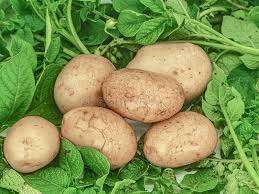
Potatoes
Solanum tuberosum
Eating this will make you ill. Listed here so you can recognise and avoid it.
A sprawling, soft-stemmed member of the nightshade family, grown for the starchy tubers that swell on underground stolons rather than for anything above ground. The leaves are pinnate with paired large and small leaflets, and the loose clusters of five-lobed white to lilac flowers give way to small green berries. Hundreds of cultivars exist, split in practice into earlies lifted young and maincrops stored through winter.
Not a native or established wild plant in Britain and Ireland. Grown in gardens, allotments and arable fields, and turning up as a short-lived casual on tips, field margins and disturbed waste ground where tubers have been discarded or missed at lifting; it rarely survives a hard winter outdoors.
Only the tubers are food, and they are eaten cooked. The stems, leaves and the small green berries contain solanine and related glycoalkaloids and should not be eaten. Tubers that have greened in the light, sprouted, or taste bitter carry raised glycoalkaloid levels — cut the green away generously or discard them. Soft, foul-smelling blight-rotted tubers are not worth salvaging.
Always use more than one reference to confirm a plant. You are responsible for what you choose to forage.
Leaves
Pinnate and alternate, with large leaflets interspersed with much smaller ones along the stalk, matt and slightly rough to the touch. Crushing them gives a rank green smell, not the sharp resinous scent of tomato foliage.
Flowers
Loose clusters of five-lobed stars, white through to pink or lilac, each with a protruding cone of yellow anthers at the centre. Flowering on earlies is the cue that tubers are worth checking.
Berries
Small round green fruits, at most 2 cm, sometimes with a purple flush. They stay green and are not edible at any stage — nothing above ground on this plant is.
Tubers
Swollen stem tissue, not root, borne on pale underground stolons and studded with eyes — dormant buds set in shallow depressions. A true root crop such as parsnip or carrot has no such buds.
Greening
Tubers exposed to light develop a grey-green tinge under the skin and a bitter taste. The colour is chlorophyll rather than the toxin itself, but the two form together, so treat green as a reason to cut deep or reject.
Updated 2026-08-08T12:02:58.344Z · Part of the shared Foragers Log catalogue · Vegetable