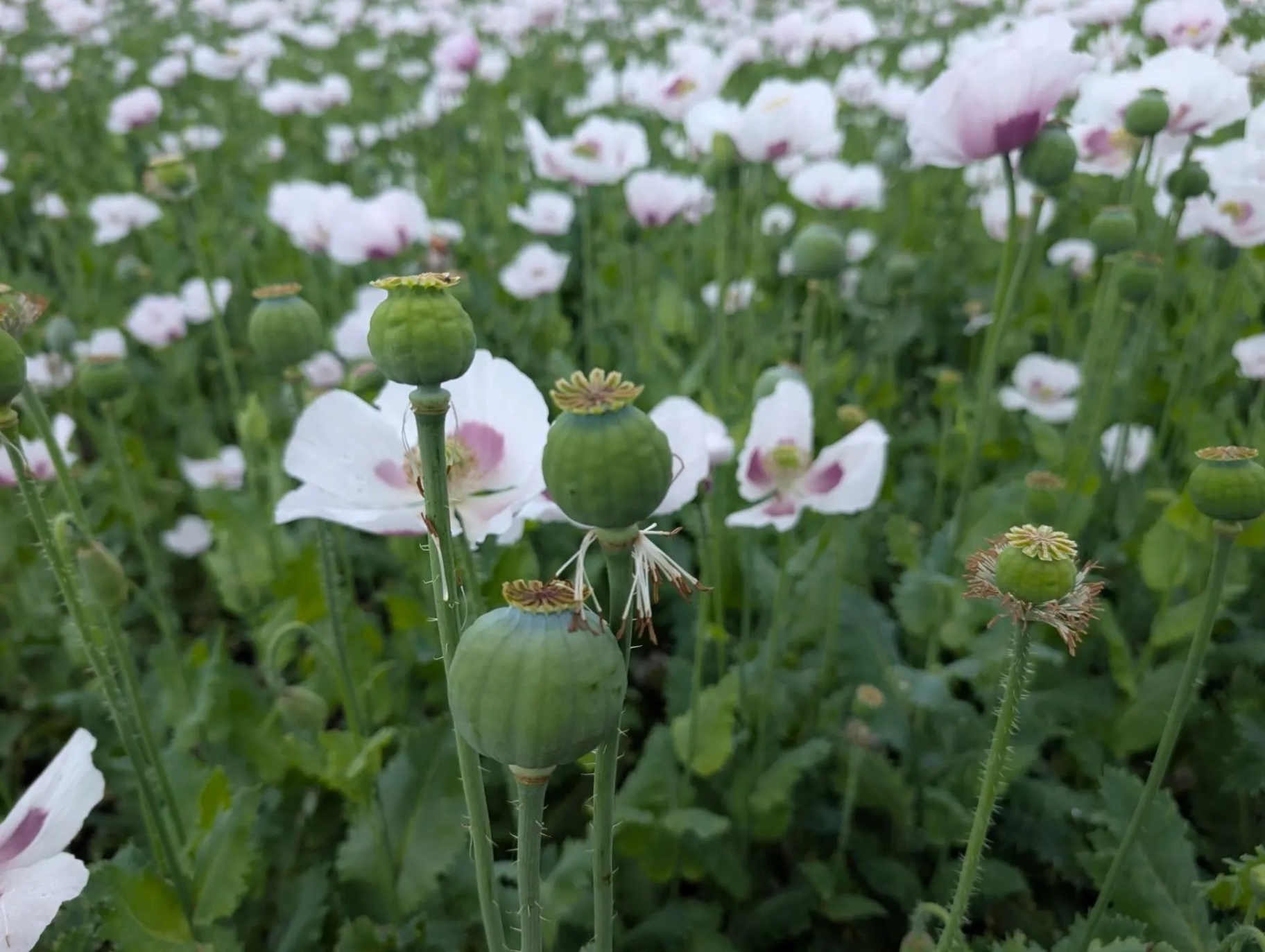
Opium Poppy
Papaver somniferum
This species is poisonous and can cause serious illness. Listed here so you can recognise and avoid it.
A tall grey-green annual, up to about 1.5m, with hairless waxy leaves that clasp the stem and large solitary flowers in white, pink, lilac or deep mauve, usually blotched dark at the petal base. The flower is followed by a smooth rounded capsule with a flat crowned top, which dries to shed thousands of tiny slate-grey seeds. Every part bleeds milky latex when cut, and it is the ripe seed alone that is used in the kitchen.
A long-standing garden plant naturalised on disturbed ground: allotments, tips, arable margins, building sites and roadside verges on light, well-drained soil. Commonest in lowland England, scattered and mostly casual further north and west.
Green capsules, stems and leaves carry the morphine- and codeine-bearing latex and are not food; poppy-head teas have caused serious poisoning. Only the ripe dry seeds are eaten, and even these can produce a positive opiate drug test. Growing the plant in the UK is lawful, but extracting the latex or preparing opium from it is an offence under the Misuse of Drugs Act 1971.
Always use more than one reference to confirm a plant. You are responsible for what you choose to forage.
Hairless, blue-grey foliage
Stems and leaves are smooth and waxy, with a distinctly glaucous blue-green cast and no bristles anywhere. Common Poppy and Long-headed Poppy are both noticeably hairy, with stiff bristles on the stems and flower buds.
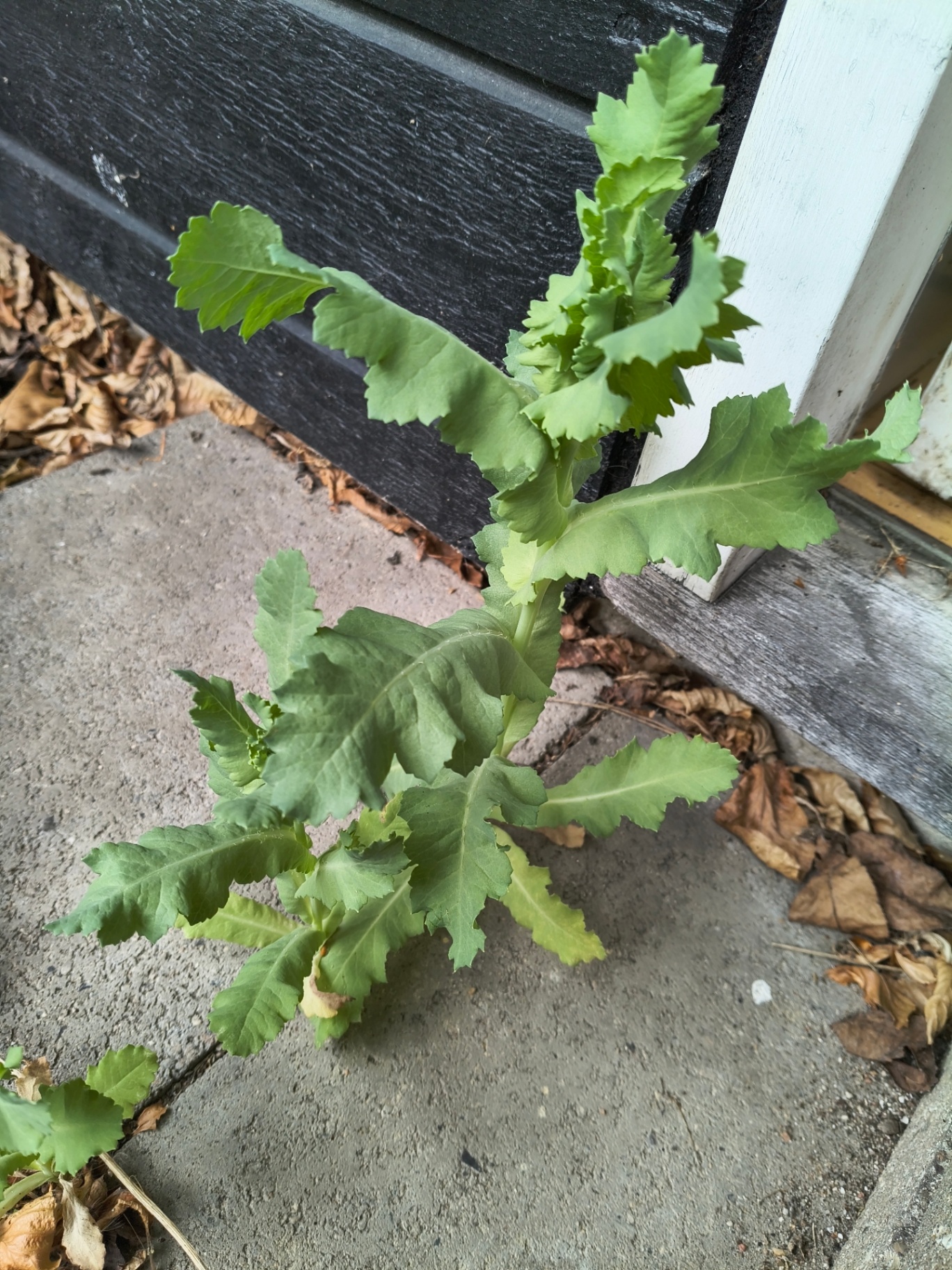
Leaves clasp the stem
The upper leaves have no stalk at all: the base of the leaf wraps around the stem and grips it. Leaves are shallowly lobed and coarsely toothed rather than finely divided, which separates it from the deeply cut, feathery leaves of the field poppies.
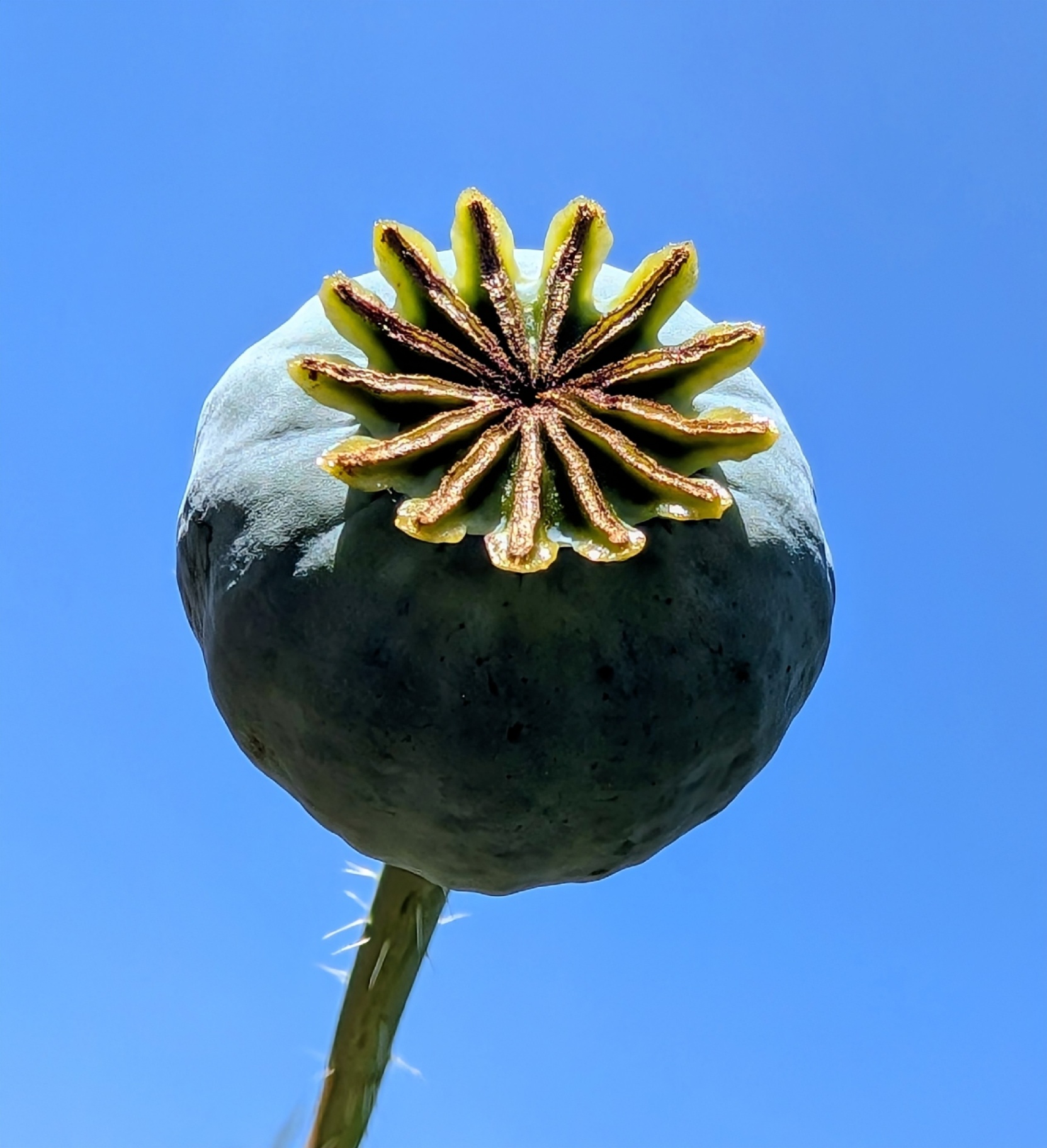
Large smooth capsule with a flat top
The seed capsule is a hairless globe or barrel up to 6cm across, capped by a flat disc with eight to fifteen rays radiating across it. It does not split open; ripe seed escapes through small pores that open under the rim of the disc. Common Poppy's capsule is much smaller and rounder.
Milky latex when cut
A cut stem, leaf or green capsule bleeds a white sap that darkens on contact with air. This is the part of the plant that carries the alkaloids. Handle with that in mind and wash your hands afterwards.
Large solitary flowers with a dark basal blotch
Petals to 5cm long, white through pink and lilac to deep mauve, nearly always with a purple-black spot at the base. Scarlet flowers on stiffly hairy stems belong to common poppy (Papaver rhoeas), which has hairy, non-clasping leaves and a short rounded capsule.
Ring of pores beneath the capsule lid
As the head ripens, small valves open in a ring just under the flat disc and the seeds shake out like a pepper pot. Shake a dry head before cutting: if nothing rattles, the seeds are still immature and the capsule is still full of latex.
Slate-grey kidney-shaped seeds
Ripe seeds are about 1mm, matt blue-grey to near-black, kidney-shaped and finely netted on the surface. Pale creamy or greenish seeds mean the head was taken green and should not be used.
Updated 2026-08-08T12:03:18.703Z · Added 2026-06-28T20:53:44.297Z
Part of the shared Foragers Log catalogue · Flower