Himalayan Balsam
Impatiens glandulifera
Eating this will make you ill. Listed here so you can recognise and avoid it.
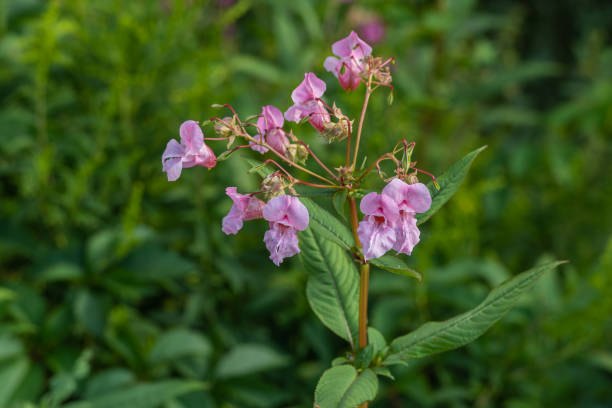
A tall pink-flowered annual, often over two metres, with hollow reddish stems that snap easily and lance-shaped, sharply toothed leaves in opposite pairs or whorls of three. The hooded flowers give it the old name policeman's helmet, and the ripe capsules burst at a touch. Seeds, flowers and cooked young shoots are all eaten, and as an aggressive invasive it is one of the few plants no one minds you stripping.
Damp, disturbed, nutrient-rich ground: riverbanks, canal sides, ditches, wet woodland edges and waste ground, usually in dense single-species stands. Introduced from the western Himalaya and now naturalised through most of Britain and Ireland.
Leaves and stems carry oxalates and mineral salts; cook them and eat modest amounts, as raw material can upset the stomach. Seeds and flowers are usually eaten raw. Under Schedule 9 of the Wildlife and Countryside Act 1981 it is an offence to plant or cause this species to grow in the wild, so carry ripe capsules in a sealed bag rather than walking seed to a new site. Riverbank stands may sit in run-off, so pick away from outfalls and treated ground.
Always use more than one reference to confirm a plant. You are responsible for what you choose to forage.
Stem
Thick, hollow and jointed, pinkish to deep red, brittle enough to snap between finger and thumb. The whole plant lifts out of wet ground on a shallow plate of roots, which is why stands collapse in a strong wind.
Flowers
Hooded and slipper-shaped, pink to purple or occasionally white, hanging in loose clusters from the upper leaf axils with a short curved spur behind. The helmet outline is visible from several metres and is the quickest confirmation in flower.
Leaves
Lance-shaped and finely toothed with red-tipped teeth, set in opposite pairs or whorls of three. Small stalked red glands sit where the leaf stalk meets the stem, the feature the species epithet refers to.
Seed capsules
Club-shaped green pods that split explosively at the lightest touch and throw seed several metres. Hold a bag or a cupped hand around the pod before you touch it, both to collect the seed and to avoid scattering it.
Updated 2026-08-07T20:41:50.522Z · Part of the shared Foragers Log catalogue · Vegetable