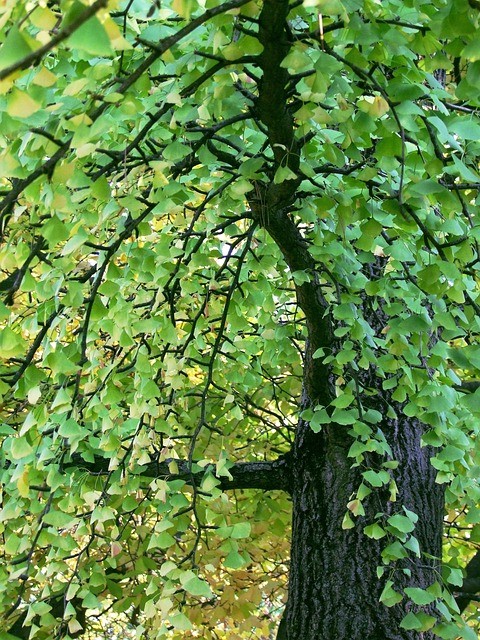
Ginkgo
Ginkgo biloba
This species is poisonous and can cause serious illness. Listed here so you can recognise and avoid it.
A tall deciduous tree with an open, often gawky crown and fan-shaped leaves, usually notched or split at the centre, that turn clear butter-yellow in autumn. It is the last survivor of an ancient lineage and grows in Britain only where it has been planted. Female trees shed fleshy, apricot-coloured seeds with a powerful rancid smell; the kernel inside is the ginkgo nut, eaten cooked and in small quantity in East Asian cooking.
Not native or naturalised in Britain and Ireland — found only as a planted tree in city streets, parks, large gardens, churchyards and botanic collections, most often in southern England where summers are warm enough to ripen seed. Tolerant of pollution and compacted soil, which is why it is a common street planting.
Raw seeds contain ginkgotoxin (4'-O-methylpyridoxine), which can cause vomiting and convulsions; poisoning cases, some serious, are recorded in East Asia. Seeds are cooked before eating and taken in small numbers only, and are not considered suitable for children. The fleshy outer seed coat contains ginkgolic acids and causes contact dermatitis in some people, so handle it with gloves. Most UK street plantings are male clones and bear no seed at all; anything gathered from a street or park tree needs the landowner's permission.
Always use more than one reference to confirm a plant. You are responsible for what you choose to forage.
Leaf
Fan-shaped, 5–8cm across, with veins radiating and forking from the stalk and no central midrib — a pattern no British broadleaf tree shares. Most leaves are notched or cleft at the broad outer edge.
Leaf arrangement
On older wood the leaves sit in tufts of three to five on stubby spur shoots a centimetre or so long; on vigorous new growth they are spaced alternately. The tufted spurs are visible from several metres away and are a quicker check than leaf shape.
Seed
Not a fruit but a naked seed with a fleshy outer coat, roughly 2.5cm, dull apricot-yellow with a waxy bloom. When trodden it smells strongly of rancid butter, which usually announces a female tree before you see it.
Kernel
Inside the flesh is a smooth, hard, cream-white shell shaped like a small almond or pistachio, containing a single green-gold kernel. Anything with a stone rather than a thin brittle shell is not ginkgo.
Bark and habit
Grey-brown, becoming deeply fissured and corky on old trunks. Young trees are narrow and sparsely branched with ascending limbs, broadening only with age.
Updated 2026-08-07T21:05:49.901Z · Part of the shared Foragers Log catalogue · Fruit