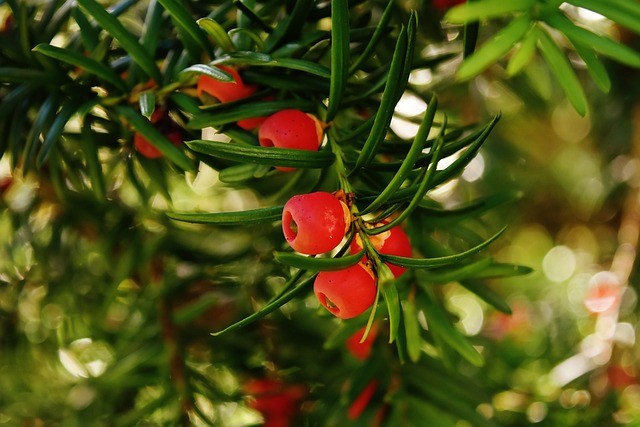
English yew
Taxus baccata
This species is deadly poisonous. Listed here so you can recognise and avoid it.
A slow-growing native evergreen conifer, usually a broad dark dome of foliage on a short fluted trunk, with thin reddish-brown bark that flakes to leave purplish patches. The needles are flat, glossy dark green above and dull pale green beneath, set in two ranks along the twig. Female trees carry single seeds held in a soft scarlet cup rather than cones. Among the longest-lived trees in Britain, and one of the most poisonous.
Native on chalk and limestone, particularly on steep scarp woodland and downland in southern England, and on limestone pavement in northern England and western Ireland. Widely planted throughout the UK and Ireland in churchyards, avenues and as clipped hedging, and self-seeding freely from those plantings.
Every part except the flesh of the red aril contains taxine alkaloids, which disturb cardiac conduction; poisoning can be rapid and fatal, and there is no reliable field first aid beyond emergency treatment. The hard seed inside the aril is deadly if chewed or crushed, and swallowing arils whole leaves no margin for error, so the tree is best treated as an identification and avoidance subject rather than a forage. Clippings stay toxic when dry and are a common cause of livestock and pet deaths.
Always use more than one reference to confirm a plant. You are responsible for what you choose to forage.
Form and bark
Typically a wide, heavily branched dome of very dark foliage on a short, fluted trunk that is often hollow in old trees, with several stems fusing at the base. The bark is thin, reddish-brown and peels in flakes to show purple-brown patches beneath, unlike the fissured grey bark of most other conifers of similar size.
Needles
Flat, soft-tipped needles 1–3cm long, glossy very dark green above and matt paler green beneath without two chalky white bands. They are spirally set but splayed into two flat ranks either side of the twig, and crushing them gives no resinous or gin-like scent, which separates yew from juniper's sharply prickly needles in whorls of three.
Seed in a red aril
The decisive feature on female trees from late summer onwards: a single hard olive-brown seed sitting in a fleshy scarlet cup that is open at the tip so the seed is visible. This is not a true berry, and no other native evergreen tree produces anything of the sort.
Cones and sexes
Trees are almost always either male or female. Males shed clouds of pale pollen from small globular cones along the undersides of the twigs in early spring; neither sex produces a woody cone, which rules out pine, spruce and larch immediately.
Updated 2026-08-07T20:37:47.903Z · Part of the shared Foragers Log catalogue · Other