Comfrey
Symphytum officinale
This species is poisonous and can cause serious illness. Listed here so you can recognise and avoid it.
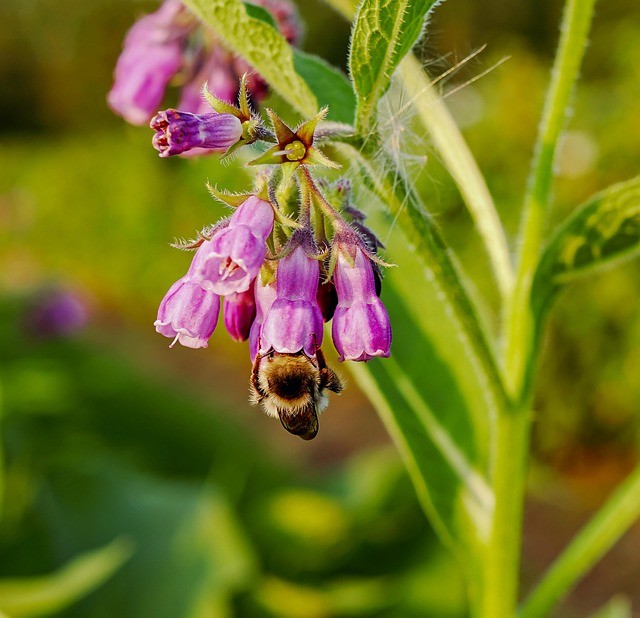
A coarse, bristly perennial reaching about a metre, with large lance-shaped leaves whose bases run down the stem as narrow wings, and nodding tubular bells of cream, pink or purple carried in tightly curled one-sided clusters. Long grown as a mulch and compost crop and used externally in tradition, it is no longer treated as an edible: the leaves and roots contain liver-damaging pyrrolizidine alkaloids.
Damp ground on riverbanks, ditch edges, wet meadows, roadside verges and waste places, usually in full sun to light shade. Widespread across lowland Britain and Ireland; the naturalised hybrid Russian comfrey is at least as frequent as the true species.
Contains pyrrolizidine alkaloids, which are cumulatively toxic to the liver, so it should not be eaten or drunk as a tea despite older books recommending it; oral comfrey preparations are restricted in the UK and traditional use is now confined to external application. The stiff bristles on stems and leaves can irritate skin on prolonged handling. Non-flowering rosettes can be taken for foxglove (Digitalis purpurea), which is deadly: comfrey leaves are harshly bristly with untoothed margins that run down onto the stem as wings, while foxglove leaves are softly grey-downy, finely toothed and sit on a clear stalk with a raised net of veins beneath.
Always use more than one reference to confirm a plant. You are responsible for what you choose to forage.
Leaf bases and stem
The leaf blade tapers into the stem and continues down it as a narrow green wing, so the stem looks ridged or flanged. This is the quickest check from a couple of metres: foxglove and green alkanet both carry their leaves on a clear stalk with no wing running down the stem.
Hairs
Stems and both leaf surfaces are covered in stiff, forward-pointing bristles that feel rasping when a leaf is drawn through the fingers. Foxglove rosette leaves feel soft and felted rather than harsh, which separates them by touch alone.
Flowers
Small nodding bells about 15mm long, cream through pink to purple, held in a cluster that uncurls like a shepherd's crook as it opens. Not a tall one-sided spike of large spotted trumpets (foxglove) and not flat blue five-petalled discs (green alkanet).
Root
A thick, brittle taproot, black to dark brown outside and white and slimy within, breaking with a mucilaginous smear. Fragments left in the ground regrow, so plants are difficult to remove once established.
Crushed leaf
Bruised leaves give off a faint cucumber-like green scent with no aromatic or garlic note. A negative result here does not confirm anything on its own, so rely on the winged stem and bristles first.
Updated 2026-08-08T11:01:30.215Z · Part of the shared Foragers Log catalogue · Fruit