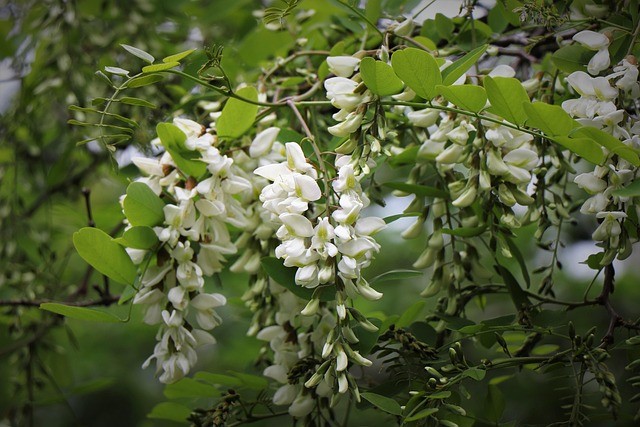
Black locust
Robinia pseudoacacia
This species is poisonous and can cause serious illness. Listed here so you can recognise and avoid it.
A fast-growing legume tree with pinnate leaves, paired spines at the leaf bases and deeply furrowed, rope-like bark. Hanging racemes of cream-white pea flowers open in late spring and are strongly scented; the flowers are the part foragers take, for fritters, syrups and sweet doughs. North American in origin, widely planted and naturalised across southern and central Britain.
Planted as a street, park and amenity tree, and naturalised on railway banks, sandy waste ground, old quarries and gravel pits, mostly in southern and central England. Nitrogen-fixing, so it holds on poor dry soils and suckers into thickets from cut stumps.
The flowers are the only part eaten. Bark, leaves, pods and seeds contain toxic lectins and glycosides and are a recorded cause of poisoning in people and in horses, so keep green stalks and pods out of the pick. Wisteria (Wisteria sinensis) carries similar hanging pea-flower racemes but is a twining climber with lilac-blue or white flowers and no spines, where this is a spiny tree. The paired spines on twigs and suckers are sharp and persist on old wood.
Always use more than one reference to confirm a plant. You are responsible for what you choose to forage.
Spines
A pair of short, stiff spines sits at the base of each leaf, where a stipule would be, and stays on the twig after the leaf falls. Wisteria and the true acacias grown in gardens have nothing of this kind at the leaf base.
Leaves
Pinnate, 15–30cm long, with 7–21 oval leaflets set in opposite pairs and a single leaflet at the tip. The leaflets are untoothed with a rounded or slightly notched end, not pointed.
Flowers
Pendulous racemes 10–20cm long of cream-white pea flowers, each with a pale yellow blotch on the upper petal, appearing after the leaves have expanded. The scent is sweet and carries several metres on a warm evening.
Bark
Grey-brown and deeply furrowed into interlacing, rope-like ridges even on fairly young trunks — coarser than any of the ash, elm or false acacia relatives it is planted alongside.
Pods
Flat, smooth, reddish-brown legumes 5–10cm long that hang on into winter after leaf fall. Useful for confirming a tree out of season, but not edible.
Updated 2026-08-07T20:41:46.489Z · Part of the shared Foragers Log catalogue · Fruit