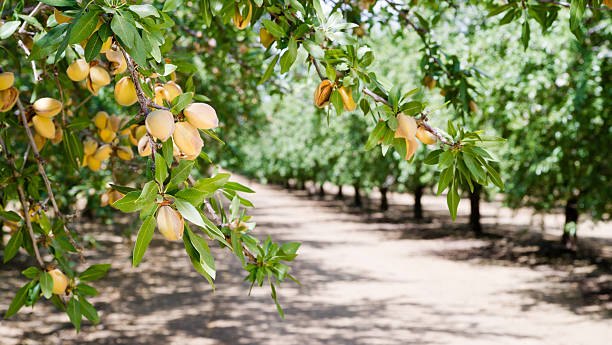
Almond
Prunus dulcis
This species is poisonous and can cause serious illness. Listed here so you can recognise and avoid it.
A small deciduous tree with narrow, finely toothed leaves and pale pink to white five-petalled blossom that opens on bare twigs in late winter. The fruit is not fleshy: a downy grey-green drupe whose thin leathery hull dries and splits to release a pale, deeply pitted stone holding the kernel. Sweet-kernelled cultivars are the source of the culinary nut; bitter-kernelled trees are a different matter entirely.
Native to the dry hills of western and central Asia and long cultivated around the Mediterranean. In Britain and Ireland it is a garden, park and street tree grown for its early blossom, doing best on light free-draining soil in a sheltered south-facing spot; it is not naturalised and ripens fruit only in hot summers.
Almond kernels contain amygdalin, which releases hydrogen cyanide when the kernel is chewed. Selected sweet cultivars carry only traces, but bitter kernels — common on ornamental and seedling trees in Britain — are dangerous in quantity and have caused deaths. A kernel that tastes sharply bitter should be spat out and the tree left alone. Tree nut allergy is common and can be severe.
Always use more than one reference to confirm a plant. You are responsible for what you choose to forage.
Blossom
Pale pink to white, five-petalled, 3–5 cm across, sitting almost stalkless in ones and twos directly on the bare twigs from February. Cherries carry their flowers in long-stalked clusters, so a bare branch studded with near-stalkless single flowers is the first sign you are looking at an almond or a peach.
Fruit
An oblong grey-green drupe 3–6 cm long, covered in fine velvety down, with a thin leathery flesh that dries and splits rather than swelling. Nothing about it is juicy — a fleshy fruit that stains the fingers is a plum, cherry or peach, not an almond.
Stone
Pale buff, flattened, and pitted all over with deep pores and grooves, teardrop-shaped in outline. Plum and cherry stones are rounder and either smooth or ridged along one seam only.
Leaves
Long and lance-shaped, 6–13 cm, finely toothed, tapering to a fine point and carried on a distinct stalk with small glands where blade meets stalk. Narrower and longer than the blunt oval leaves of plums.
Kernel taste
A sweet kernel is mild and nutty; a bitter one is overwhelmingly, unmistakably bitter within a second or two. Bitterness means high amygdalin — spit it out, rinse, and take nothing further from that tree.
Updated 2026-08-07T20:41:54.097Z · Part of the shared Foragers Log catalogue · Fruit