The Best Foraging Apps in the UK (2026)
Last reviewed 21 August 2026
I built one of the apps on this list. It is not the first entry, and I have written honestly about what it does badly. If that bothers you, the short version is: for identifying a plant from a photo, use Pl@ntNet. Everything below is the longer version.
Most “best foraging app” roundups are written for the United States. The top-ranking one at the time of writing is from 2020, and its examples are a red-tailed hawk in Brooklyn and recipes organised around the Copenhagen season. Useful, if you live there.
The UK is a different problem. Our wild food is different, our species are different, and — this is the part almost no app handles — our land access and conservation law are different, and they vary between England, Scotland, Wales and Northern Ireland. An app that knows what a plant is can still leave you standing on an SSSI with a bag of something you were not entitled to remove.
So rather than rank six apps against each other, here they are grouped by the job they actually do.
Best for identifying a plant from a photo: Pl@ntNet
Free. No subscription, no ads, no upsell.
Pl@ntNet is a non-profit research initiative run by a consortium of French research institutes. You photograph a leaf, flower, fruit or bark, and it returns ranked species suggestions with confidence scores drawn from a community-verified image database.
Two things make it the right default here. It lets you select a regional flora, so you can constrain suggestions to Western Europe rather than getting a North American congener that does not grow here. And because it is research-funded rather than subscription-funded, there is no paywall waiting three taps in.
What it is not: a foraging app. It will happily identify a plant that will make you very ill, with no warning, because telling you what to eat is not its job.
Best for contributing to biological records: iNaturalist
Free.
iNaturalist grew out of the California Academy of Sciences and the National Geographic Society, and it is a citizen science platform first and an identification tool second. Your observations get reviewed by other users, and records that reach research grade flow through to GBIF and are genuinely used by scientists.
If you care about your walks contributing something beyond your own notebook, this is the one. UK coverage is strong and the community is active.
What it is not: focused on edibility. There is no distinction in iNaturalist between a blackberry and a bittersweet nightshade beyond the species name. It also has no concept of UK protected sites or protected species — it is a global platform and the local legal layer simply is not there.
Best for urban fruit trees: Falling Fruit
Free on the web. 99p one-off on mobile — no subscription, no ads.
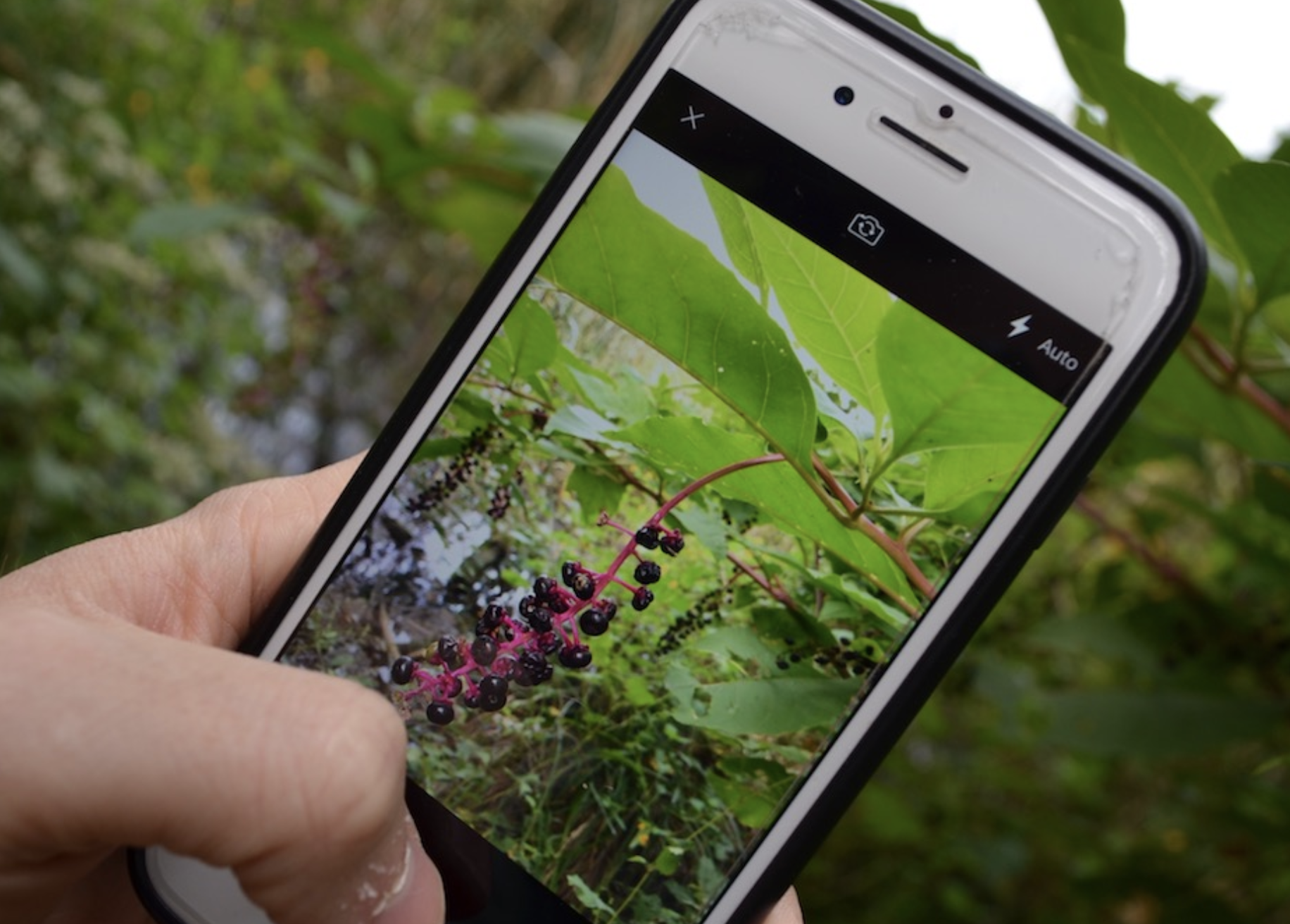
Falling Fruit is a volunteer-run 501(c)(3) based in Colorado that has assembled a global map of edible plants — roughly a million locations across more than 1,200 edible types, combining user contributions with imported municipal tree inventories. For finding a public damson tree in a city, nothing else comes close on raw coverage.
That map exists because a small volunteer team has been building it since 2013 and giving it away. The code is open source, the data is openly licensed, and a fair number of other projects in this space are built partly on their work — mine included. It is the closest thing urban foraging has to a commons, and it was assembled by people doing it in their own time.
One caveat, and it is structural rather than organisational. A large share of the map is imported bulk data, and an imported record has no date attached to the thing you actually care about — whether the tree is still there and still fruiting. This is the most common complaint in its reviews, and it is not a bug anyone can fix; it is what happens when you merge live contributions with static inventories. It applies to Foragers Log too, which carries 8,434 imported Falling Fruit records — see the disclosure further down.
The mobile app is actively maintained. The separate mobile codebase was retired — its repository was archived on 25 June 2026 — because maintaining a website and an app that shared no code proved too time-consuming, and the app is now built from the same falling-fruit-web codebase as the website.
Correction, 21 August 2026: an earlier version of this post read the archived repository as a sign that development attention had moved away from the mobile app. That was wrong. The app is maintained, from the shared web codebase. Thanks to Ethan Welty at Falling Fruit for the correction.
Best if you want plant care and will pay for it: PictureThis
Free tier is thin. Paid subscription, roughly £25–£35 a year, depending on region and promotion.
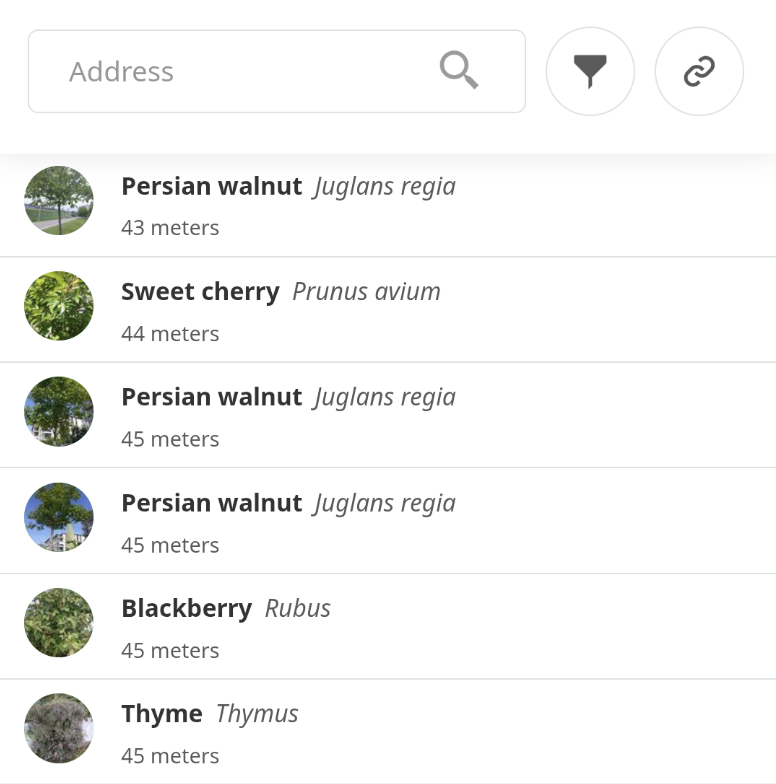
PictureThis is the app most people have heard of, and its identification accuracy on common plants is genuinely very good. It is also the most complained-about payment model in this category. It runs a seven-day free trial that auto-converts to an annual subscription unless you cancel, and the cancellation deadline is not made prominent. “How to cancel PictureThis” is one of the most-searched phrases attached to the product, which tells you most of what you need to know.
It is built for gardeners rather than foragers — the paid features are care reminders, watering schedules, and disease diagnosis. For a forager, you are paying for a plant-care product to get identification that you can have for free from Pl@ntNet.
Check the current price on your own app store before starting the trial. It moves, and it differs by country.
Best for UK land rules and logging what you find: Foragers Log
Free. No ads, no subscription, no account required to browse.
This is mine, so treat the description as a specification rather than a recommendation.
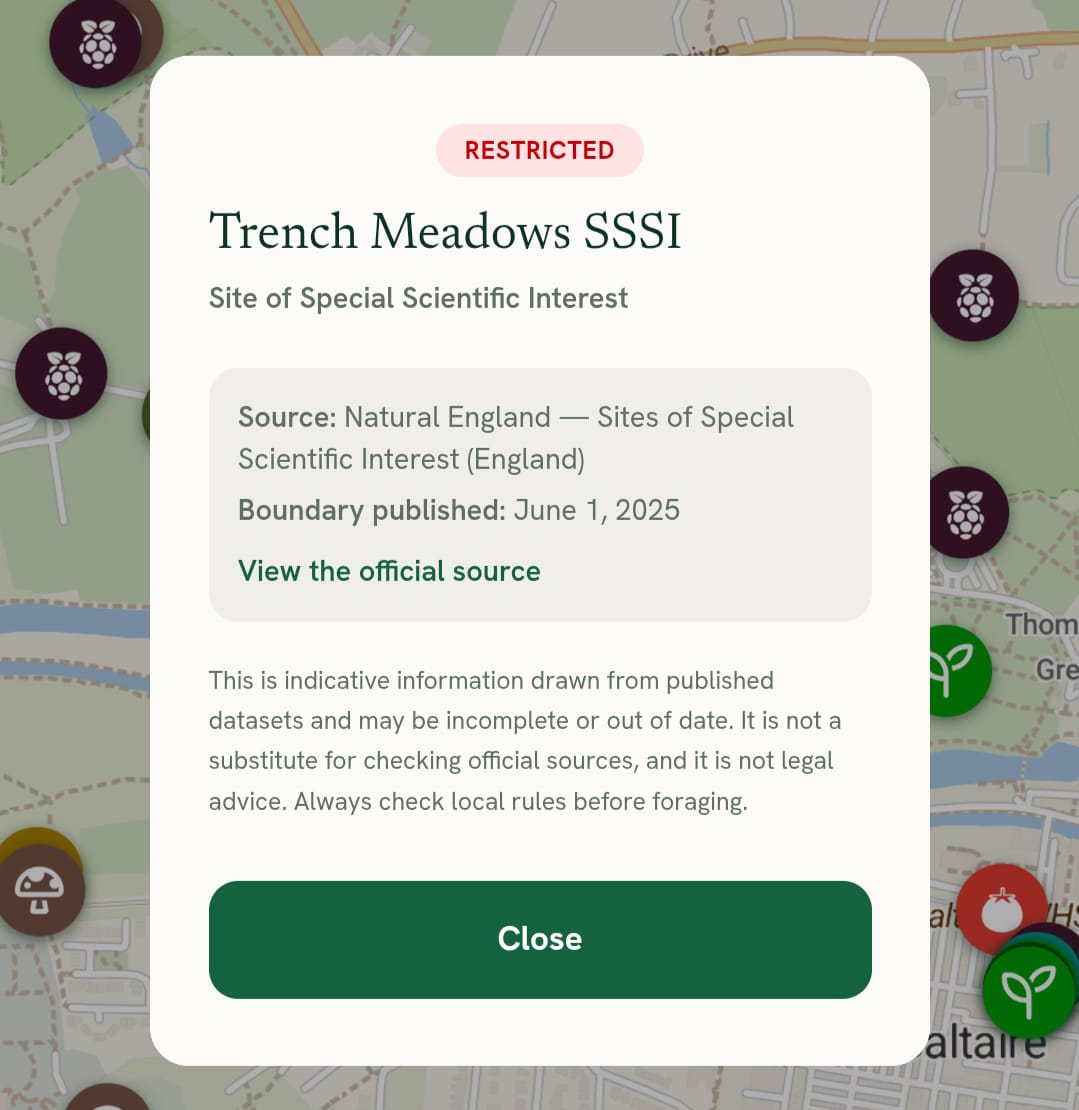
It does one thing no other app on this list does: it overlays statutory protected-area boundaries for all four UK nations, ingested from Natural England, NatureScot and DataMapWales, so you can see whether where you are standing carries restrictions before you pick. It also carries a “commonly confused with” section on every species entry, severity-graded, covering the lookalikes that actually matter rather than every superficially similar plant.
Identification is Pl@ntNet under the hood, so on that axis it is exactly as good as Pl@ntNet and no better. Every logged find records how it was identified — self-selected, AI-verified, or AI-suggested — so the shared map does not present a guess as a certainty.
Disclosure. 8,434 locations on the Foragers Log map are imported Falling Fruit records, used under CC BY-NC-SA with attribution — figure correct at 21 August 2026. Each is shown with a Falling Fruit credit and the original record date. The imported-data caveat I made above applies to them here exactly as it does there: an imported record is a claim from a dataset, not a dated find by a person. Where the map shows a logged observation instead, that is someone’s dated record of what they saw.
Where it loses: the species catalog is smaller than iNaturalist’s by orders of magnitude, because every entry is written and verified by hand against published references. If you want breadth, this is the wrong app. There is also no saved-locations feature yet, which Falling Fruit does better.
What none of these apps do well
Mushrooms. Photo identification of fungi is not reliable enough to eat on, and no app on this list claims otherwise. Spore prints, smell, cut-flesh colour change, substrate and season all matter and none of them are in a photograph. Use apps to narrow a shortlist, then use a book, and for anything in a genus with a dangerous member, use a person.
The law. Identification apps are built globally and the UK’s rules are local. Uprooting a wild plant without the landowner’s permission is an offence under the Wildlife and Countryside Act 1981, some species carry additional statutory protection, and the picture differs across the four nations. No general-purpose ID app will tell you this, because it is not what they are for.
Telling you it is safe. None of these apps can, including mine. They give you information; the decision to eat something is yours, and the honest ones say so.
The short answer
If you install one app, install Pl@ntNet — it is free, accurate, and asks nothing of you.
If you want your finds to count for something, add iNaturalist.
If you are in a town or city and want to know where the fruit trees are, add Falling Fruit. Nothing else has the coverage, and it is worth the 99p.
If you are in the UK and want to know where you are allowed to be before you pick, that is the gap the rest of this list leaves, and it is the one I built Foragers Log to fill.
And buy a book. Every experienced forager I know owns several.
- apps
- comparison
- uk
- foraging law
- identification
Sources
- Falling Fruit — fallingfruit.org, accessed 21 August 2026
- Falling Fruit — datasets and data licensing — fallingfruit.org, accessed 21 August 2026
- Falling Fruit on Google Play — play.google.com, accessed 21 August 2026
- Falling Fruit — falling-fruit-web repository (current app codebase) — github.com, accessed 21 August 2026
- Falling Fruit — legacy mobile app repository (archived 25 June 2026) — github.com, accessed 13 August 2026
- Falling Fruit — organisation repositories — github.com, accessed 13 August 2026
- Falling Fruit on the App Store — apps.apple.com, accessed 13 August 2026
- PictureThis on the App Store — apps.apple.com, accessed 13 August 2026
- Pl@ntNet — plantnet.org, accessed 13 August 2026
- iNaturalist — inaturalist.org, accessed 13 August 2026